China-Taiwan Tensions: Military Activities Raise Security Fears

- Update Time : 04:44:01 pm, Monday, 16 November 2026
- / 33 View
China Increases Military Activities Around Taiwan Amid Rising Tensions
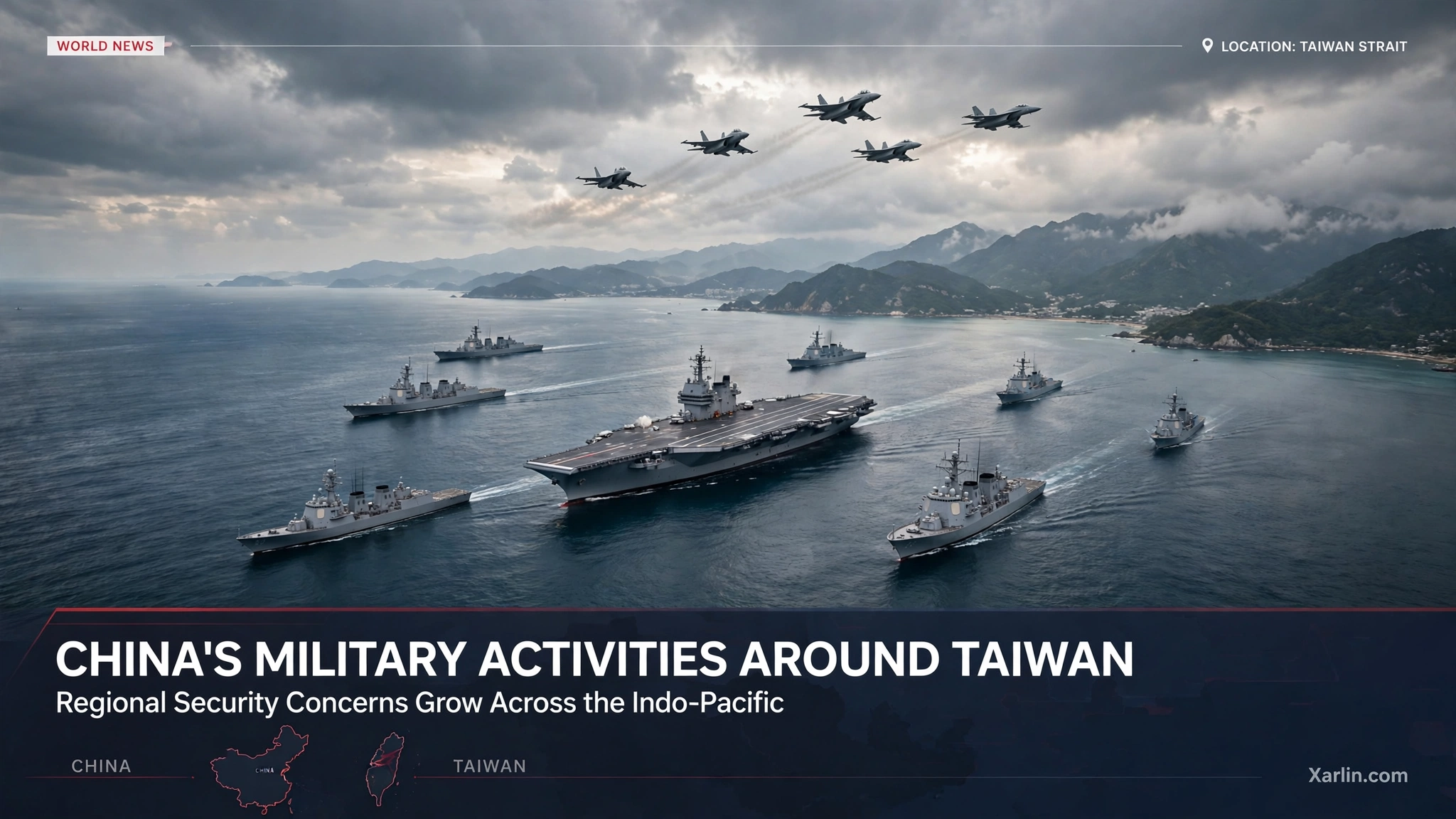
China’s growing military activities around Taiwan are raising fresh concerns about regional security, as naval vessels, military aircraft and coast guard ships continue operating across the Taiwan Strait and the wider western Pacific.
Recent developments have drawn international attention after Taiwanese officials reported large-scale Chinese military exercises involving more than 100 naval and coast guard vessels earlier this month.
The activities, which included operations across different areas of the western Pacific, have increased concerns about the military balance in East Asia and the possibility of further tensions between Beijing and Taipei.
According to a Reuters report published on November 13, Taiwanese officials described the unannounced exercises as a form of “silent intimidation” aimed at increasing pressure on Taiwan and other governments ahead of major international diplomatic meetings.
Meanwhile, Taiwan’s Ministry of National Defense continues to monitor Chinese military movements around the island and has reported the presence of aircraft and naval vessels in surrounding areas.
The developments have once again placed the Taiwan Strait at the centre of international security discussions.
China Conducts Large-Scale Military Exercises Near Taiwan
China conducted an extensive, unannounced military exercise across the western Pacific and around Taiwan in early November, according to a Reuters investigation.
A senior Taiwanese security official said more than 100 Chinese naval and coast guard vessels had gathered in the region at one point during the exercises.
The reported activities included simulated attacks involving military forces and urban targets, including scenarios involving Taiwan.
The exercises reportedly involved naval formations from China’s eastern, northern and southern military commands.
Taiwanese officials expressed concern that the scale and coordination of the operations could indicate preparations for more complex military scenarios, including attempts to restrict access to the island.
China did not publicly announce the exercises as a formal military operation.
Beijing has described the movements of its aircraft carrier and associated naval forces as routine military activities.
Taiwan Reports Chinese Military Aircraft and Naval Vessels
Taiwan’s Ministry of National Defense continues to publish daily reports about Chinese military activities around the island.
In its November 16 update, covering the 24-hour period from 6 a.m. on November 15 to 6 a.m. on November 16, Taiwan reported detecting four sorties of Chinese military aircraft, seven Chinese naval vessels and three official ships operating around Taiwan.
According to the ministry, all four aircraft sorties crossed the median line of the Taiwan Strait and entered Taiwan’s central, southwestern and eastern air defence identification zone.
Taiwan’s armed forces monitored the activities and used aircraft, naval vessels and coastal missile systems in response.
The figures represent Taiwan’s official monitoring of military movements during the reported period. They do not independently establish that an attack was imminent.
Why the Taiwan Strait Is Strategically Important
The Taiwan Strait is one of the most strategically important waterways in East Asia.
Located between mainland China and Taiwan, the strait is an important route for international maritime transportation and regional trade.
The surrounding waters also connect important shipping routes across the western Pacific.
Taiwan itself has a significant role in the global technology industry, particularly in semiconductor manufacturing.
The island produces advanced chips used in smartphones, computers, artificial intelligence systems, vehicles and other electronic products.
Any serious military confrontation or prolonged disruption around Taiwan could therefore have consequences beyond East Asia.
Potential effects could include:
- Disruption to international shipping routes.
- Delays in global semiconductor production.
- Increased regional military tensions.
- Financial market uncertainty.
- Greater pressure on international diplomatic relations.
These risks explain why governments and businesses around the world closely monitor developments in the Taiwan Strait.
Taiwan Raises Concerns Over China’s Naval Activities
Taiwanese officials have expressed concern about the growing scale of China’s military presence in the western Pacific.
Taiwan’s Defence Minister Wellington Koo previously described China’s naval exercises as area-denial operations, suggesting they could be designed to restrict the ability of outside forces to enter the region during a potential conflict.
The exercises involved China’s Liaoning aircraft carrier group and other naval formations.
According to Reuters reporting, Taiwanese officials believe the activities could reflect preparations for operations extending beyond the immediate waters surrounding Taiwan.
China, however, maintains that its military activities are legitimate exercises and has not publicly confirmed that the reported operations were intended to prepare for a blockade of Taiwan.
The competing interpretations highlight the continuing strategic disagreements between Beijing and Taipei.
What Is China’s Position on Taiwan?
China considers Taiwan part of its territory and has repeatedly stated that national reunification is a major political objective.
Beijing has not ruled out using force to achieve reunification, although it says it prefers peaceful means.
Taiwan, meanwhile, operates with its own democratically elected government, military and political institutions.
The island’s government rejects Beijing’s claim that the People’s Republic of China has sovereignty over Taiwan.
These opposing positions have created one of the most sensitive geopolitical disputes in the Indo-Pacific region.
The United States also plays an important role in the situation through its security relationship with Taiwan and its broader strategic presence in the region.
International Concerns Over Regional Stability
The increasing military activity around Taiwan has implications for countries throughout the Indo-Pacific.
Japan, South Korea, the Philippines and other regional countries have strong economic and security interests in maintaining stability across the western Pacific.
A major conflict involving China and Taiwan could disrupt international trade, damage regional economies and create serious diplomatic challenges for neighbouring governments.
The United States also remains closely involved in discussions about regional security.
International observers are particularly concerned about the possibility of military miscalculations, accidental confrontations or an escalation caused by misunderstandings between military forces operating in close proximity.
Maintaining communication channels and avoiding unnecessary escalation will therefore remain important for regional stability.
What Could Happen Next?
The situation around Taiwan remains uncertain as China continues its military activities and Taiwan strengthens its monitoring and defence preparations.
Future developments will depend on decisions made by political and military leaders in Beijing, Taipei and Washington.
Diplomatic meetings and international discussions could provide opportunities to reduce tensions, although major disagreements over Taiwan’s political status remain unresolved.
Regional governments are also expected to continue monitoring Chinese naval movements, military aircraft activity and developments across the western Pacific.
For now, the latest military activities serve as a reminder of the importance of the Taiwan Strait to international security and the global economy.
Conclusion
China’s military activities around Taiwan have renewed international concerns about security and stability in East Asia.
The recent unannounced exercises, increased naval deployments and continued aircraft activity demonstrate the growing strategic importance of the Taiwan Strait.
Although the latest developments do not mean that a military conflict is inevitable, they highlight the risks associated with rising tensions between Beijing and Taipei.
As major international powers continue to monitor the situation, maintaining regional stability and preventing military escalation will remain important priorities for the international community.
Sources: Reuters, Taiwan Ministry of National Defense and the Institute for the Study of War.
XARLIN DESK