Singapore 12:18 pm, Wednesday, 25 November 2026

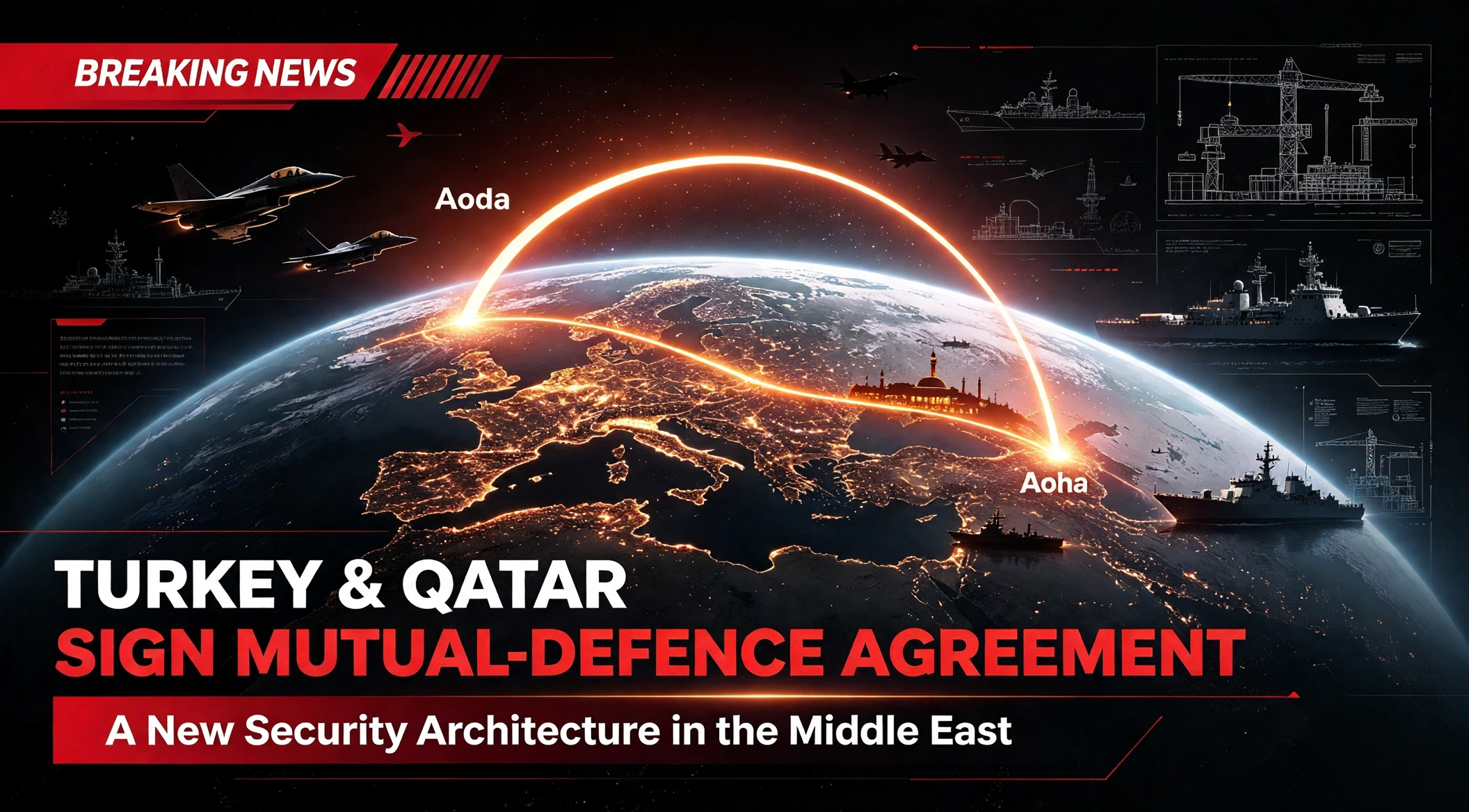
Turkey & Qatar Sign Mutual‑Defence Agreement – Shifting Regional Power Dynamics

  • Update Time : 02:15:42 pm, Saturday, 14 November 2026
  • / 34 View

In a move that redraws the security map of the Middle East, Turkey and Qatar have formally signed a mutual defence agreement during the 12th session of the Turkey-Qatar Supreme Strategic Committee, held in Istanbul on November 13, 2026. The landmark pact commits both nations to take a unified stance in the event of an external armed attack against either country, deepening a strategic partnership that has grown steadily over the past decade.

What the Agreement Contains

The core commitment of the new defence pact is straightforward but significant: an attack on one party will be treated as a threat to the security of the other, triggering coordinated consultation and mutual support. While full operational details remain confidential, official statements confirm the agreement covers several key areas:

  • Collective security commitment: Both nations will take a unified position in the event of an external armed attack
  • Enhanced military cooperation: More frequent joint exercises, coordinated training programmes, and information sharing
  • Defence industry collaboration: Joint research, development, and production of military systems
  • Strategic consultation: Regular high-level meetings to align positions on regional security crises

Alongside the defence treaty, the two nations also signed the Badr Memorandum — a quadrilateral defence industry cooperation framework involving Turkey, Qatar, Pakistan, and Indonesia. This separate accord establishes a joint manufacturing alliance aimed at reducing reliance on Western arms suppliers, creating shared supply chains, and developing indigenous military technology across the four nations. Additional agreements covering trade, energy cooperation, and cultural exchange were also finalised during the summit.

Turkish President Recep Tayyip Erdoğan described the agreement as more than a security measure: “This is not just about defending borders. It is about building a region that stands on its own feet — capable of protecting its own peace and shaping its own future.” Qatar’s Emir, Sheikh Tamim bin Hamad Al Thani, emphasised the pact’s defensive nature: “We do not seek confrontation. We seek strength through partnership — so that our voice is heard and our security is protected.”

A Relationship Deep in the Making

This agreement did not happen overnight. Turkey and Qatar have steadily built one of the most durable partnerships in the region since 2017, when Turkey established a significant military base at Qatar’s Tariq bin Ziyad camp near Doha — its first permanent military installation in the Gulf. That deployment initially faced scepticism from some regional capitals, but it proved critical during periods of heightened tension in the Persian Gulf. Over time, the base evolved from a token presence into a fully integrated training hub capable of projecting air, land, and maritime power across the Arabian Peninsula.

Economically, too, the two nations have become deeply intertwined. Qatar has invested billions of dollars in Turkey’s infrastructure, real estate, and banking sectors, providing crucial financial support during periods of economic volatility in Ankara. In return, Turkey has become one of Qatar’s primary defence technology partners, supplying armed drones, naval vessels, and security systems that Doha previously sourced from Europe or the United States. The new defence agreement effectively formalises what was already a functioning strategic alliance — elevating it from cooperation to a treaty-level security guarantee.

Regional Implications: A Changing Security Order

The timing of this agreement is particularly noteworthy. Across the Middle East, countries are reassessing their security commitments amid shifting global power dynamics. Long-standing U.S. security guarantees are no longer viewed as unquestionable, and regional powers are actively diversifying their diplomatic and military partnerships. This agreement fits squarely within that trend — a recognition that in an uncertain world, hedging bets and building overlapping alliances is becoming the preferred strategy for smaller and medium-sized nations seeking greater autonomy.

For Turkey, the pact strengthens its position as a bridge between regions — extending its strategic influence from the Eastern Mediterranean through the Gulf and potentially into South Asia via the Badr initiative. It complements a separate but parallel agreement signed in August 2026 under the Makkah Joint Defence Pact between Turkey, Pakistan, and Saudi Arabia — an accord that similarly contains a mutual security guarantee. Viewed together, these agreements suggest Ankara is weaving together a network of partnerships that no single Western power can claim, positioning Turkey as an independent security provider across multiple regions.

For Qatar, the agreement diversifies its security umbrella beyond the U.S.-led alliance system. While Doha remains home to the largest U.S. air base in the Middle East at Al Udeid, the Turkish pact provides an additional layer of protection and diplomatic leverage. It sends a clear message: Qatar has options and allies beyond Washington, and it intends to shape its own defence strategy rather than simply receiving orders from abroad. This independence was evident during the recent diplomatic rift with several Gulf states, when Turkey stood firmly by Qatar — a decision that paid dividends in trust and enduring friendship.

How Other Capitals Are Responding

Unsurprisingly, the agreement has drawn mixed reactions across the region. Saudi Arabia, which recently signed its own defence pact with Turkey, has taken a pragmatic stance — viewing Ankara’s expanding regional role as complementary rather than competitive. Riyadh did not join the Istanbul agreement, maintaining its preference for narrower, issue-based alliances rather than broad mutual defence commitments. Iran has expressed cautious concern, with officials noting that any new military alignment near its borders requires transparency and reassurance. Tehran has long viewed foreign military bases in the Gulf as a source of instability, and while the Turkish-Qatari pact is not directed against Iran, its very existence alters the strategic balance in ways that Iranian analysts will monitor closely.

Israel and Egypt — both traditional U.S. allies — have also observed the development with interest. Neither country has issued an official response, but regional analysts suggest the emergence of a Turkey-led security network complicates long-standing assumptions about who holds influence in the Middle East. If nations in the region increasingly look to Ankara rather than Washington or Brussels for security leadership, decades-old diplomatic alignments could gradually shift. The United States has remained neutral in its public comments, noting that it “respects the sovereignty of our partners to make their own security arrangements” — a diplomatic phrasing that masks deeper questions about America’s long-term strategic posture in the region.

Opportunities and Risks Ahead

The Turkey-Qatar defence agreement opens new possibilities but also carries inherent risks. On the positive side, it creates a model of regional self-reliance — demonstrating that countries in the Middle East can organise their own security dialogue without waiting for external powers to intervene. It also promotes defence industrialisation across multiple nations, potentially creating jobs, technology transfer, and economic resilience in an industry historically dominated by Western giants. For smaller nations like Qatar, it offers a counterbalance to larger regional powers — a classic example of strategic balancing in international relations.

Yet challenges remain. The agreement does not specify clear triggers for military intervention, leaving ambiguity about exactly what scenarios would compel one nation to fight on behalf of the other. Critics also question whether Turkey has the military capacity to honour multiple defence commitments simultaneously — with Qatar, Saudi Arabia, and potentially others — while managing its existing operational burdens at home and on its borders. If a crisis were to erupt in the Gulf and the Eastern Mediterranean at the same time, Ankara could face difficult choices that test the credibility of all its new promises.

Furthermore, there is the risk of bloc formation. If one set of countries aligns around Turkey, could a rival coalition emerge around another power? A more polarised Middle East could reduce diplomatic flexibility and make de-escalation harder during crises. The goal of stability through partnership could inadvertently produce stability through division — a more dangerous arrangement for everyone involved.

The Path Forward

For now, the agreement represents a significant milestone in regional politics without being a revolution. U.S. forces remain in Qatar; traditional alliances persist; trade continues as before. But beneath the surface, the architecture of security is quietly being rebuilt. Nations across the Middle East are asking the same question: Can we rely on others to defend us when the moment comes? Increasingly, their answer is: We must also be able to defend ourselves — together.

Turkey and Qatar have stepped forward with one answer to that question. Whether others follow, or whether this creates new tensions that require their own management, will unfold in the months and years ahead. What is certain is that the era when one external power could shape the region’s destiny alone is fading. The Middle East is taking greater control of its own security — for better or for worse — and the world will need to adjust to that new reality.


Tags:
XARLIN DESK

Turkey & Qatar Sign Mutual‑Defence Agreement – Shifting Regional Power Dynamics

Update Time : 02:15:42 pm, Saturday, 14 November 2026

In a move that redraws the security map of the Middle East, Turkey and Qatar have formally signed a mutual defence agreement during the 12th session of the Turkey-Qatar Supreme Strategic Committee, held in Istanbul on November 13, 2026. The landmark pact commits both nations to take a unified stance in the event of an external armed attack against either country, deepening a strategic partnership that has grown steadily over the past decade.

What the Agreement Contains

The core commitment of the new defence pact is straightforward but significant: an attack on one party will be treated as a threat to the security of the other, triggering coordinated consultation and mutual support. While full operational details remain confidential, official statements confirm the agreement covers several key areas:

  • Collective security commitment: Both nations will take a unified position in the event of an external armed attack
  • Enhanced military cooperation: More frequent joint exercises, coordinated training programmes, and information sharing
  • Defence industry collaboration: Joint research, development, and production of military systems
  • Strategic consultation: Regular high-level meetings to align positions on regional security crises

Alongside the defence treaty, the two nations also signed the Badr Memorandum — a quadrilateral defence industry cooperation framework involving Turkey, Qatar, Pakistan, and Indonesia. This separate accord establishes a joint manufacturing alliance aimed at reducing reliance on Western arms suppliers, creating shared supply chains, and developing indigenous military technology across the four nations. Additional agreements covering trade, energy cooperation, and cultural exchange were also finalised during the summit.

Turkish President Recep Tayyip Erdoğan described the agreement as more than a security measure: “This is not just about defending borders. It is about building a region that stands on its own feet — capable of protecting its own peace and shaping its own future.” Qatar’s Emir, Sheikh Tamim bin Hamad Al Thani, emphasised the pact’s defensive nature: “We do not seek confrontation. We seek strength through partnership — so that our voice is heard and our security is protected.”

A Relationship Deep in the Making

This agreement did not happen overnight. Turkey and Qatar have steadily built one of the most durable partnerships in the region since 2017, when Turkey established a significant military base at Qatar’s Tariq bin Ziyad camp near Doha — its first permanent military installation in the Gulf. That deployment initially faced scepticism from some regional capitals, but it proved critical during periods of heightened tension in the Persian Gulf. Over time, the base evolved from a token presence into a fully integrated training hub capable of projecting air, land, and maritime power across the Arabian Peninsula.

Economically, too, the two nations have become deeply intertwined. Qatar has invested billions of dollars in Turkey’s infrastructure, real estate, and banking sectors, providing crucial financial support during periods of economic volatility in Ankara. In return, Turkey has become one of Qatar’s primary defence technology partners, supplying armed drones, naval vessels, and security systems that Doha previously sourced from Europe or the United States. The new defence agreement effectively formalises what was already a functioning strategic alliance — elevating it from cooperation to a treaty-level security guarantee.

Regional Implications: A Changing Security Order

The timing of this agreement is particularly noteworthy. Across the Middle East, countries are reassessing their security commitments amid shifting global power dynamics. Long-standing U.S. security guarantees are no longer viewed as unquestionable, and regional powers are actively diversifying their diplomatic and military partnerships. This agreement fits squarely within that trend — a recognition that in an uncertain world, hedging bets and building overlapping alliances is becoming the preferred strategy for smaller and medium-sized nations seeking greater autonomy.

For Turkey, the pact strengthens its position as a bridge between regions — extending its strategic influence from the Eastern Mediterranean through the Gulf and potentially into South Asia via the Badr initiative. It complements a separate but parallel agreement signed in August 2026 under the Makkah Joint Defence Pact between Turkey, Pakistan, and Saudi Arabia — an accord that similarly contains a mutual security guarantee. Viewed together, these agreements suggest Ankara is weaving together a network of partnerships that no single Western power can claim, positioning Turkey as an independent security provider across multiple regions.

For Qatar, the agreement diversifies its security umbrella beyond the U.S.-led alliance system. While Doha remains home to the largest U.S. air base in the Middle East at Al Udeid, the Turkish pact provides an additional layer of protection and diplomatic leverage. It sends a clear message: Qatar has options and allies beyond Washington, and it intends to shape its own defence strategy rather than simply receiving orders from abroad. This independence was evident during the recent diplomatic rift with several Gulf states, when Turkey stood firmly by Qatar — a decision that paid dividends in trust and enduring friendship.

How Other Capitals Are Responding

Unsurprisingly, the agreement has drawn mixed reactions across the region. Saudi Arabia, which recently signed its own defence pact with Turkey, has taken a pragmatic stance — viewing Ankara’s expanding regional role as complementary rather than competitive. Riyadh did not join the Istanbul agreement, maintaining its preference for narrower, issue-based alliances rather than broad mutual defence commitments. Iran has expressed cautious concern, with officials noting that any new military alignment near its borders requires transparency and reassurance. Tehran has long viewed foreign military bases in the Gulf as a source of instability, and while the Turkish-Qatari pact is not directed against Iran, its very existence alters the strategic balance in ways that Iranian analysts will monitor closely.

Israel and Egypt — both traditional U.S. allies — have also observed the development with interest. Neither country has issued an official response, but regional analysts suggest the emergence of a Turkey-led security network complicates long-standing assumptions about who holds influence in the Middle East. If nations in the region increasingly look to Ankara rather than Washington or Brussels for security leadership, decades-old diplomatic alignments could gradually shift. The United States has remained neutral in its public comments, noting that it “respects the sovereignty of our partners to make their own security arrangements” — a diplomatic phrasing that masks deeper questions about America’s long-term strategic posture in the region.

Opportunities and Risks Ahead

The Turkey-Qatar defence agreement opens new possibilities but also carries inherent risks. On the positive side, it creates a model of regional self-reliance — demonstrating that countries in the Middle East can organise their own security dialogue without waiting for external powers to intervene. It also promotes defence industrialisation across multiple nations, potentially creating jobs, technology transfer, and economic resilience in an industry historically dominated by Western giants. For smaller nations like Qatar, it offers a counterbalance to larger regional powers — a classic example of strategic balancing in international relations.

Yet challenges remain. The agreement does not specify clear triggers for military intervention, leaving ambiguity about exactly what scenarios would compel one nation to fight on behalf of the other. Critics also question whether Turkey has the military capacity to honour multiple defence commitments simultaneously — with Qatar, Saudi Arabia, and potentially others — while managing its existing operational burdens at home and on its borders. If a crisis were to erupt in the Gulf and the Eastern Mediterranean at the same time, Ankara could face difficult choices that test the credibility of all its new promises.

Furthermore, there is the risk of bloc formation. If one set of countries aligns around Turkey, could a rival coalition emerge around another power? A more polarised Middle East could reduce diplomatic flexibility and make de-escalation harder during crises. The goal of stability through partnership could inadvertently produce stability through division — a more dangerous arrangement for everyone involved.

The Path Forward

For now, the agreement represents a significant milestone in regional politics without being a revolution. U.S. forces remain in Qatar; traditional alliances persist; trade continues as before. But beneath the surface, the architecture of security is quietly being rebuilt. Nations across the Middle East are asking the same question: Can we rely on others to defend us when the moment comes? Increasingly, their answer is: We must also be able to defend ourselves — together.

Turkey and Qatar have stepped forward with one answer to that question. Whether others follow, or whether this creates new tensions that require their own management, will unfold in the months and years ahead. What is certain is that the era when one external power could shape the region’s destiny alone is fading. The Middle East is taking greater control of its own security — for better or for worse — and the world will need to adjust to that new reality.