Singapore 5:09 pm, Wednesday, 25 November 2026

Singapore and China Announce 29 Agreements at 22nd High-Level Meeting

  • Update Time : 04:07:14 pm, Monday, 23 November 2026
  • / 18 View

Singapore and China Hold 22nd High-Level Meeting, Announce 29 Cooperation Agreements

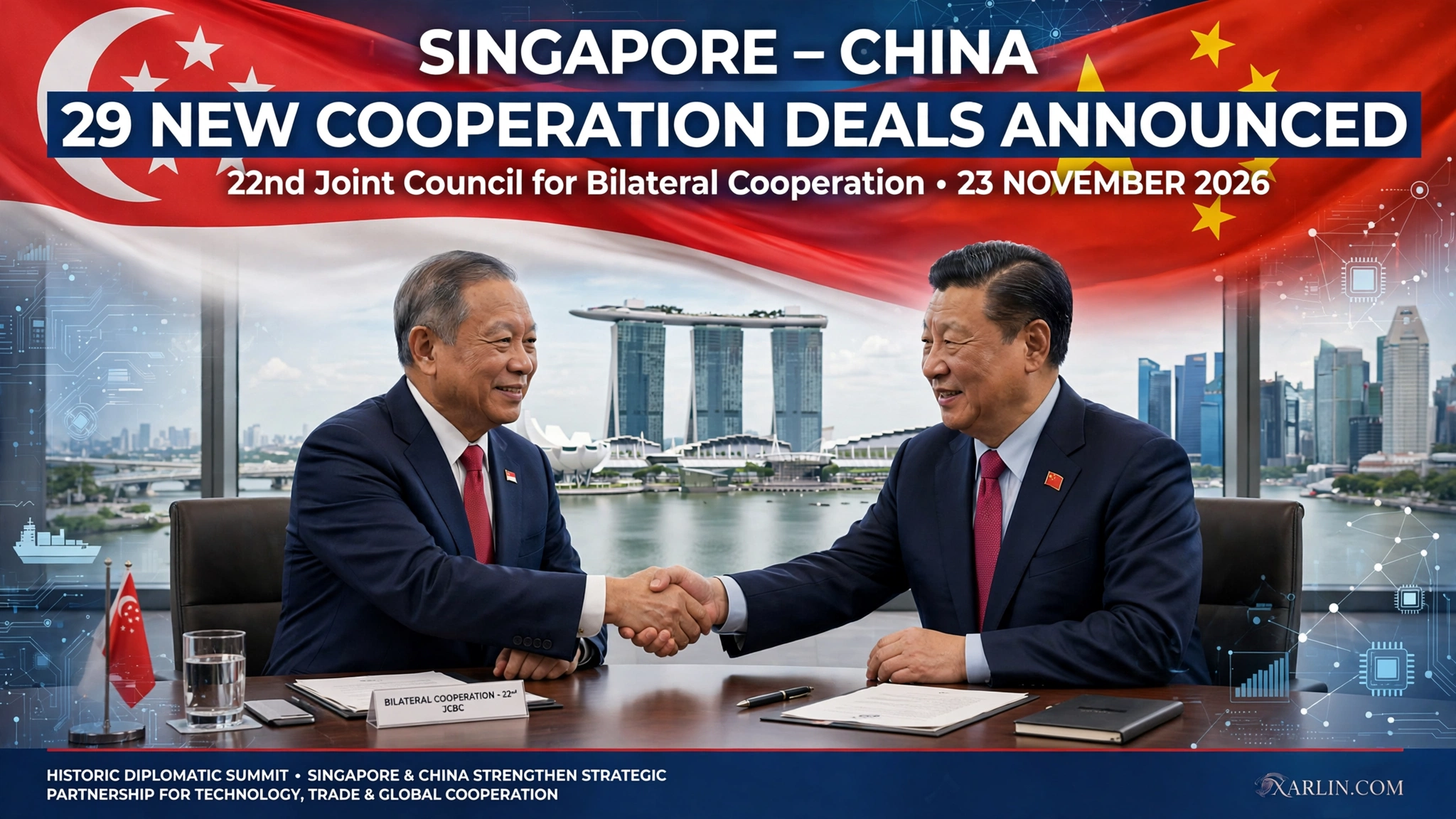
SINGAPORE, November 23, 2026 – Singapore and China have announced 29 new agreements and cooperation initiatives following their 22nd Joint Council for Bilateral Cooperation (JCBC) meeting, marking another step in strengthening economic, technological and diplomatic relations between the two countries.

The high-level meeting took place in Singapore on Monday and was co-chaired by Singapoe Depruty Prime Minister Gan Kim Yong and Chinese Vice Premier Ding Xuexiang.

The discussions covered several important areas, including international trade, digital technology, artificial intelligence (AI), financial services, healthcare, education, food security and scientific research.

The meeting also reviewed progress on three major government-to-government cooperation projects involving Suzhou Industrial Park, Tianjin Eco-City and the China-Singapore (Chongqing) Demonstration Initiative on Strategic Connectivity.

According to Singapore’s Ministry of Foreign Affairs, the 29 announced memorandums of understanding (MOUs), agreements and other deliverables reflect the expanding relationship between the two countries.

Singapore and China Strengthen Economic and Trade Cooperation

Trade and economic cooperation were among the central topics discussed during the meeting.

Both countries agreed to deepen collaboration in trade in services and explore additional opportunities for businesses operating in Singapore and China.

One important development was the renewal of an agreement on cooperation in trade in services. The initiative aims to create opportunities for businesses in sectors such as healthcare, tourism, professional services, legal services, eldercare and sustainability.

Singapore and China also discussed launching negotiations to upgrade the China-Singapore Free Trade Agreement, known as CSFTA 4.0.

The proposed upgrade is expected to address changing international trade conditions, particularly the growing importance of digital trade and cross-border economic activities.

Deputy Prime Minister Gan Kim Yong said the planned upgrade could help facilitate trade between the two countries, including cooperation in digital trade and cross-border data flows.

However, negotiations will take time, and the upgraded agreement has not yet been finalised.

Artificial Intelligence and Digital Economy Take Centre Stage

Digital technology and artificial intelligence were also important areas of discussion.

Singapore and China announced new cooperation initiatives involving digital trade, technological innovation and industrial development.

One agreement involves Singapore’s Ministry of Energy and Trade and Industry, China’s Ministry of Commerce and the Chongqing Municipal Government.

The initiative aims to develop a more efficient digital trade environment connecting Southeast Asia with western China through Singapore and Chongqing.

The cooperation will explore areas such as digital trade documentation, electronic commercial documents and cross-border recognition of digital records.

Both countries also discussed opportunities for cooperation in artificial intelligence, including AI applications, governance, robotics and smart manufacturing.

Singapore’s Minister for Digital Development and Information Josephine Teo highlighted the potential for AI-powered robotics and automation to support businesses, particularly in areas where companies face manpower constraints.

These developments could create additional opportunities for technology companies, research institutions and businesses interested in expanding into regional markets.

Financial Cooperation and Cross-Border Payments

Financial connectivity was another major subject during the 22nd JCBC meeting.

Singapore and China are exploring ways to make financial transactions between the two countries more convenient for businesses and individuals.

One initiative involves establishing a connection between their fast payment systems to support small-value cross-border transfers.

If implemented, the system could make it easier for people and businesses to transfer money between Singapore and China.

The two countries also discussed strengthening cooperation involving the Chinese renminbi (RMB).

Singapore’s Monetary Authority and China’s financial authorities are exploring several initiatives, including enhanced RMB financing facilities and closer cooperation between financial institutions.

These developments could support international trade, investment and business financing.

Deputy Prime Minister Gan Kim Yong said improved financial connectivity could make it easier for Singapore-based businesses to access the Chinese market and support growth in commerce and tourism.

Singapore Expands Food Supply Options Through China’s Hainan Province

Food security was another significant outcome of the meeting.

Singapore has approved China’s Hainan Province to export frozen and chilled poultry, frozen and chilled pork, and poultry shell eggs to Singapore.

This development expands Singapore’s available food supply sources and creates additional opportunities for food producers in Hainan.

Hainan is the first Chinese province to receive this accreditation for the relevant poultry and egg exports.

The decision is particularly relevant to Singapore because the country imports a substantial proportion of its food requirements.

Expanding the number of approved food suppliers can help diversify supply sources and strengthen food resilience.

For Singaporean consumers, the development could eventually mean more choices in the local food market, depending on importers’ decisions and product availability.

Healthcare, Science and Education Cooperation

The agreements also cover cooperation in healthcare, scientific research, education and public health.

Singapore and China announced initiatives to strengthen research and development partnerships between institutions in both countries.

Areas of cooperation include:

  • Healthcare and medical research.
  • Infectious disease research.
  • Forensic science.
  • Agricultural science and technology.
  • Environmental protection.
  • Public health and disease prevention.
  • Medical product regulatory cooperation.

One agreement involves Singapore’s Health Sciences Authority and China’s relevant institutions to advance research and development in forensic sciences.

Another initiative will support cooperation between Singapore’s Communicable Diseases Agency and China’s National Disease Control and Prevention Administration.

These partnerships are intended to encourage knowledge-sharing, research collaboration and the exchange of professional expertise.

Three Major Government-to-Government Projects Reviewed

During the meeting, officials also reviewed progress on three long-standing cooperation projects between Singapore and China.

1. Suzhou Industrial Park

The Suzhou Industrial Park is one of the longest-running cooperation projects between the two countries.

Both sides discussed opportunities to expand collaboration in digital development, intelligent industries, biomedical sciences and green development.

2. Tianjin Eco-City

The Tianjin Eco-City project focuses on sustainable urban development and environmental innovation.

The two countries are exploring ways to expand cooperation into additional areas, including economic development, research, housing and people-to-people exchanges.

3. China-Singapore (Chongqing) Demonstration Initiative on Strategic Connectivity

This project aims to strengthen economic and logistics connections between western China and Southeast Asia.

It also supports greater connectivity in trade, transportation, financial services and regional business activities.

Together, these projects represent important platforms for long-term economic and technological cooperation.

Singapore and China Also Expand Sports Cooperation

Beyond trade and economic development, the two countries are strengthening people-to-people connections.

One of the 29 announced initiatives involves a memorandum of understanding between the Singapore National Olympic Council and the Chinese Olympic Committee.

The agreement aims to encourage greater cooperation between sporting organisations, athletes and other stakeholders.

Potential areas include sports exchanges, international sporting affairs, regular dialogue and participation in competitions.

This reflects the broader scope of Singapore-China relations, which extends beyond government and business cooperation.

What Do the Agreements Mean for Singapore and China?

The latest developments could create opportunities across several parts of both economies.

For businesses, improved digital trade arrangements and financial connectivity could make cross-border commercial activities easier.

Technology companies may benefit from additional research partnerships and opportunities in artificial intelligence, robotics and smart manufacturing.

Food importers and consumers could also benefit from the expansion of Singapore’s approved food supply sources.

Meanwhile, cooperation in healthcare, education and scientific research could encourage greater knowledge-sharing between institutions.

However, the actual impact will depend on how quickly the announced initiatives are implemented and how businesses and institutions use the new opportunities.

Conclusion

The 22nd Joint Council for Bilateral Cooperation meeting marks another important development in Singapore-China relations.

With 29 new agreements and cooperation initiatives covering trade, finance, technology, healthcare, food security and scientific research, both countries are seeking to strengthen their partnership in an increasingly connected global economy.

The planned upgrade of the China-Singapore Free Trade Agreement and discussions on digital trade and financial connectivity will be important areas to watch in the coming months.

As Singapore continues to strengthen its role as a regional business and financial centre, closer cooperation with China could create additional opportunities for companies and institutions across Southeast Asia.

The next JCBC meeting is expected to take place in China in 2027, providing another opportunity for both countries to review progress and explore new areas of cooperation.

Source: Singapore Ministry of Foreign Affairs – 22nd JCBC Meeting.


XARLIN DESK

Singapore and China Announce 29 Agreements at 22nd High-Level Meeting

Update Time : 04:07:14 pm, Monday, 23 November 2026

Singapore and China Hold 22nd High-Level Meeting, Announce 29 Cooperation Agreements

SINGAPORE, November 23, 2026 – Singapore and China have announced 29 new agreements and cooperation initiatives following their 22nd Joint Council for Bilateral Cooperation (JCBC) meeting, marking another step in strengthening economic, technological and diplomatic relations between the two countries.

The high-level meeting took place in Singapore on Monday and was co-chaired by Singapoe Depruty Prime Minister Gan Kim Yong and Chinese Vice Premier Ding Xuexiang.

The discussions covered several important areas, including international trade, digital technology, artificial intelligence (AI), financial services, healthcare, education, food security and scientific research.

The meeting also reviewed progress on three major government-to-government cooperation projects involving Suzhou Industrial Park, Tianjin Eco-City and the China-Singapore (Chongqing) Demonstration Initiative on Strategic Connectivity.

According to Singapore’s Ministry of Foreign Affairs, the 29 announced memorandums of understanding (MOUs), agreements and other deliverables reflect the expanding relationship between the two countries.

Singapore and China Strengthen Economic and Trade Cooperation

Trade and economic cooperation were among the central topics discussed during the meeting.

Both countries agreed to deepen collaboration in trade in services and explore additional opportunities for businesses operating in Singapore and China.

One important development was the renewal of an agreement on cooperation in trade in services. The initiative aims to create opportunities for businesses in sectors such as healthcare, tourism, professional services, legal services, eldercare and sustainability.

Singapore and China also discussed launching negotiations to upgrade the China-Singapore Free Trade Agreement, known as CSFTA 4.0.

The proposed upgrade is expected to address changing international trade conditions, particularly the growing importance of digital trade and cross-border economic activities.

Deputy Prime Minister Gan Kim Yong said the planned upgrade could help facilitate trade between the two countries, including cooperation in digital trade and cross-border data flows.

However, negotiations will take time, and the upgraded agreement has not yet been finalised.

Artificial Intelligence and Digital Economy Take Centre Stage

Digital technology and artificial intelligence were also important areas of discussion.

Singapore and China announced new cooperation initiatives involving digital trade, technological innovation and industrial development.

One agreement involves Singapore’s Ministry of Energy and Trade and Industry, China’s Ministry of Commerce and the Chongqing Municipal Government.

The initiative aims to develop a more efficient digital trade environment connecting Southeast Asia with western China through Singapore and Chongqing.

The cooperation will explore areas such as digital trade documentation, electronic commercial documents and cross-border recognition of digital records.

Both countries also discussed opportunities for cooperation in artificial intelligence, including AI applications, governance, robotics and smart manufacturing.

Singapore’s Minister for Digital Development and Information Josephine Teo highlighted the potential for AI-powered robotics and automation to support businesses, particularly in areas where companies face manpower constraints.

These developments could create additional opportunities for technology companies, research institutions and businesses interested in expanding into regional markets.

Financial Cooperation and Cross-Border Payments

Financial connectivity was another major subject during the 22nd JCBC meeting.

Singapore and China are exploring ways to make financial transactions between the two countries more convenient for businesses and individuals.

One initiative involves establishing a connection between their fast payment systems to support small-value cross-border transfers.

If implemented, the system could make it easier for people and businesses to transfer money between Singapore and China.

The two countries also discussed strengthening cooperation involving the Chinese renminbi (RMB).

Singapore’s Monetary Authority and China’s financial authorities are exploring several initiatives, including enhanced RMB financing facilities and closer cooperation between financial institutions.

These developments could support international trade, investment and business financing.

Deputy Prime Minister Gan Kim Yong said improved financial connectivity could make it easier for Singapore-based businesses to access the Chinese market and support growth in commerce and tourism.

Singapore Expands Food Supply Options Through China’s Hainan Province

Food security was another significant outcome of the meeting.

Singapore has approved China’s Hainan Province to export frozen and chilled poultry, frozen and chilled pork, and poultry shell eggs to Singapore.

This development expands Singapore’s available food supply sources and creates additional opportunities for food producers in Hainan.

Hainan is the first Chinese province to receive this accreditation for the relevant poultry and egg exports.

The decision is particularly relevant to Singapore because the country imports a substantial proportion of its food requirements.

Expanding the number of approved food suppliers can help diversify supply sources and strengthen food resilience.

For Singaporean consumers, the development could eventually mean more choices in the local food market, depending on importers’ decisions and product availability.

Healthcare, Science and Education Cooperation

The agreements also cover cooperation in healthcare, scientific research, education and public health.

Singapore and China announced initiatives to strengthen research and development partnerships between institutions in both countries.

Areas of cooperation include:

  • Healthcare and medical research.
  • Infectious disease research.
  • Forensic science.
  • Agricultural science and technology.
  • Environmental protection.
  • Public health and disease prevention.
  • Medical product regulatory cooperation.

One agreement involves Singapore’s Health Sciences Authority and China’s relevant institutions to advance research and development in forensic sciences.

Another initiative will support cooperation between Singapore’s Communicable Diseases Agency and China’s National Disease Control and Prevention Administration.

These partnerships are intended to encourage knowledge-sharing, research collaboration and the exchange of professional expertise.

Three Major Government-to-Government Projects Reviewed

During the meeting, officials also reviewed progress on three long-standing cooperation projects between Singapore and China.

1. Suzhou Industrial Park

The Suzhou Industrial Park is one of the longest-running cooperation projects between the two countries.

Both sides discussed opportunities to expand collaboration in digital development, intelligent industries, biomedical sciences and green development.

2. Tianjin Eco-City

The Tianjin Eco-City project focuses on sustainable urban development and environmental innovation.

The two countries are exploring ways to expand cooperation into additional areas, including economic development, research, housing and people-to-people exchanges.

3. China-Singapore (Chongqing) Demonstration Initiative on Strategic Connectivity

This project aims to strengthen economic and logistics connections between western China and Southeast Asia.

It also supports greater connectivity in trade, transportation, financial services and regional business activities.

Together, these projects represent important platforms for long-term economic and technological cooperation.

Singapore and China Also Expand Sports Cooperation

Beyond trade and economic development, the two countries are strengthening people-to-people connections.

One of the 29 announced initiatives involves a memorandum of understanding between the Singapore National Olympic Council and the Chinese Olympic Committee.

The agreement aims to encourage greater cooperation between sporting organisations, athletes and other stakeholders.

Potential areas include sports exchanges, international sporting affairs, regular dialogue and participation in competitions.

This reflects the broader scope of Singapore-China relations, which extends beyond government and business cooperation.

What Do the Agreements Mean for Singapore and China?

The latest developments could create opportunities across several parts of both economies.

For businesses, improved digital trade arrangements and financial connectivity could make cross-border commercial activities easier.

Technology companies may benefit from additional research partnerships and opportunities in artificial intelligence, robotics and smart manufacturing.

Food importers and consumers could also benefit from the expansion of Singapore’s approved food supply sources.

Meanwhile, cooperation in healthcare, education and scientific research could encourage greater knowledge-sharing between institutions.

However, the actual impact will depend on how quickly the announced initiatives are implemented and how businesses and institutions use the new opportunities.

Conclusion

The 22nd Joint Council for Bilateral Cooperation meeting marks another important development in Singapore-China relations.

With 29 new agreements and cooperation initiatives covering trade, finance, technology, healthcare, food security and scientific research, both countries are seeking to strengthen their partnership in an increasingly connected global economy.

The planned upgrade of the China-Singapore Free Trade Agreement and discussions on digital trade and financial connectivity will be important areas to watch in the coming months.

As Singapore continues to strengthen its role as a regional business and financial centre, closer cooperation with China could create additional opportunities for companies and institutions across Southeast Asia.

The next JCBC meeting is expected to take place in China in 2027, providing another opportunity for both countries to review progress and explore new areas of cooperation.

Source: Singapore Ministry of Foreign Affairs – 22nd JCBC Meeting.