The Bermuda Triangle Mystery: What Really Happens in This Mysterious Part of the Atlantic Ocean?

- Update Time : 04:41:32 pm, Saturday, 21 November 2026
- / 24 View
The Bermuda Triangle Mystery: What Really Happens in This Mysterious Part of the Atlantic Ocean?
The Atlantic Ocean is home to some of the world’s busiest shipping routes, fascinating marine environments and unexplored underwater landscapes. Yet, one particular region has attracted global attention for decades because of stories involving missing ships, vanished aircraft and unexplained maritime disasters.
Known as the Bermuda Triangle, this mysterious region has become one of the most famous subjects in modern maritime history.
For generations, stories about ships disappearing without warning and aircraft losing communication have encouraged people to question what might be happening beneath the ocean’s surface.
Some believe the region is connected to supernatural forces, extraterrestrial activity or mysterious underwater phenomena. Others argue that its reputation has been exaggerated by popular books, television programmes and incomplete historical accounts.
But what does the available evidence actually tell us?
To understand the Bermuda Triangle, it is necessary to look beyond the legends and examine the historical disappearances, scientific explanations and official investigations that have shaped its reputation.
Where Is the Bermuda Triangle?
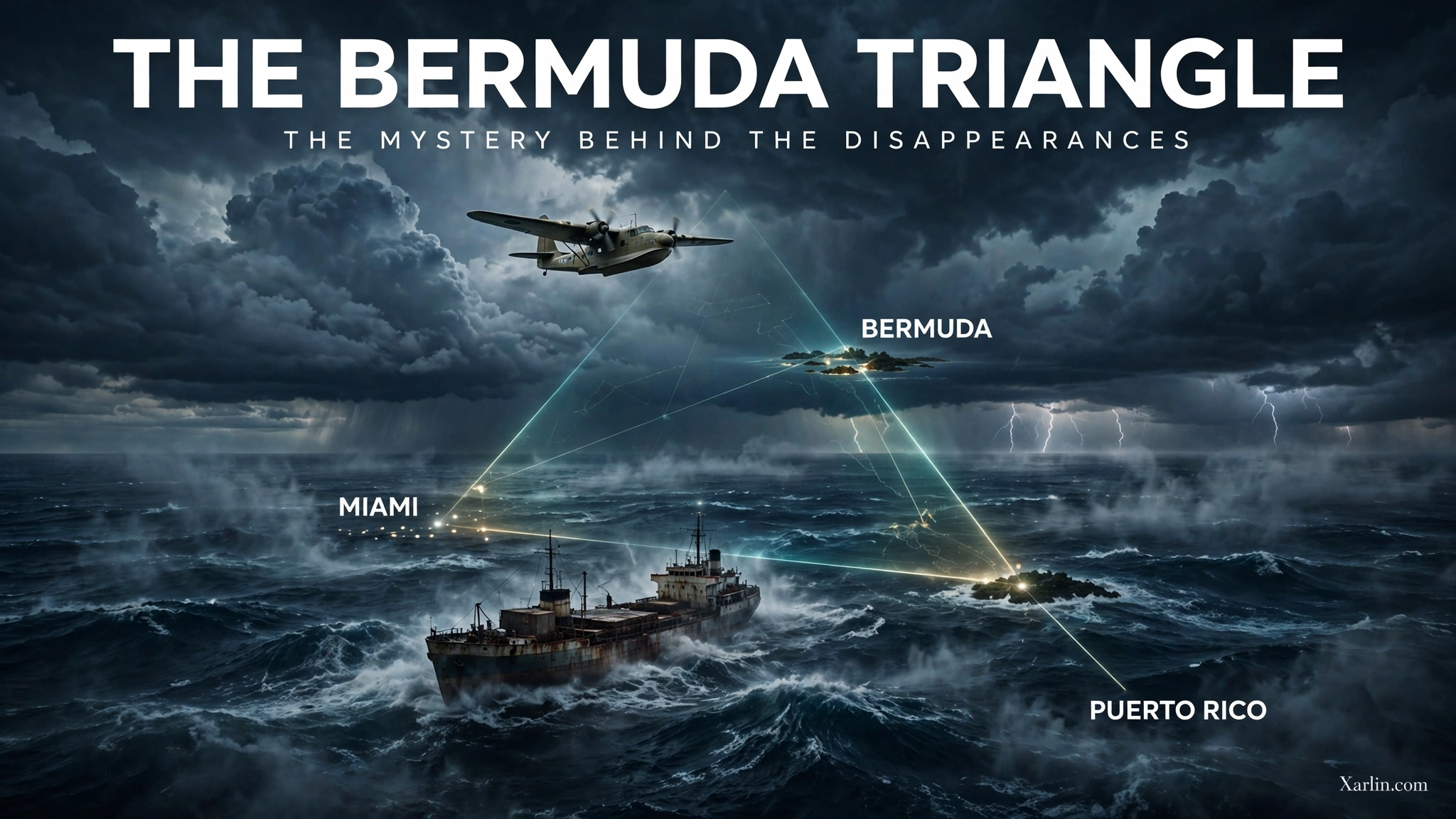
The Bermuda Triangle is generally described as an area of the western North Atlantic Ocean connecting three geographical locations:
- Miami, Florida, United States
- Bermuda, a British Overseas Territory
- San Juan, Puerto Rico
These three locations form the approximate triangular area that gave the region its famous name.
However, an important detail is often overlooked: the Bermuda Triangle does not have officially recognised geographical boundaries.
The United States government does not officially recognise it as a distinct geographical region, and it does not appear as a specially designated danger zone on standard navigational charts.
According to the National Oceanic and Atmospheric Administration (NOAA), there is no evidence that mysterious disappearances occur more frequently in this region than in other large, heavily travelled areas of the ocean.
Despite this, its reputation continues to attract researchers, historians, travellers and curious readers worldwide.
How Did the Bermuda Triangle Become Famous?
The Bermuda Triangle did not become famous overnight.
Reports of unusual incidents in the western Atlantic existed long before the name became internationally recognised. However, public interest increased significantly during the twentieth century.
In 1964, American writer Vincent Gaddis popularised the term “Bermuda Triangle” through an article titled The Deadly Bermuda Triangle, published in Argosy magazine.
The subject received even greater international attention in the 1970s, particularly following the publication of Charles Berlitz’s bestselling book about the region.
Books and media reports collected different maritime and aviation disappearances into one mysterious narrative.
Over time, these accounts helped establish the Bermuda Triangle as a symbol of unexplained events at sea.
However, historical research suggests that some popular accounts included inaccurate details, exaggerated descriptions or incidents that did not actually occur within the commonly described boundaries.
This distinction between historical evidence and popular storytelling remains essential when investigating the mystery.
The Disappearance of Flight 19: One of Aviation History’s Greatest Mysteries
Perhaps no incident contributed more to the Bermuda Triangle legend than the disappearance of Flight 19.
On 5 December 1945, five United States Navy Avenger torpedo bombers departed from Naval Air Station Fort Lauderdale in Florida for a routine training mission.
The aircraft carried 14 crew members.
The mission initially appeared ordinary. However, the situation became increasingly concerning when the flight leader, Lieutenant Charles Taylor, reportedly experienced navigational difficulties.
Radio communications indicated that the pilots were uncertain about their position.
As the situation developed, the aircraft became increasingly disoriented.
The pilots attempted to determine their location, but communication problems and navigation difficulties complicated their efforts.
Eventually, the five aircraft disappeared over the Atlantic Ocean.
A rescue aircraft carrying 13 additional crew members was also dispatched to search for the missing bombers. That aircraft subsequently disappeared as well.
A major search operation followed, but neither the five training aircraft nor the rescue aircraft was recovered.
The disappearance of 27 people created a lasting historical mystery.
However, historians and aviation researchers have suggested several possible explanations, including navigational confusion, fuel exhaustion and difficult weather conditions.
The exact circumstances remain uncertain because the aircraft wreckage has not been conclusively identified.
The incident became one of the most frequently discussed events associated with the Bermuda Triangle.
USS Cyclops: The Ship That Disappeared Without a Trace
Another major mystery associated with the Bermuda Triangle involves the USS Cyclops.
In March 1918, the United States Navy cargo ship USS Cyclops disappeared while travelling from the Caribbean towards Baltimore.
The vessel was carrying approximately 10,000 tons of manganese ore and had more than 300 people aboard.
The ship was commanded by Lieutenant Commander George W. Worley.
After departing Barbados, the USS Cyclops was expected to continue its journey towards the United States.
However, it never arrived at its destination.
No confirmed distress signal was received, and extensive searches failed to locate the vessel or establish exactly what happened.
The disappearance remains one of the largest non-combat losses of life in United States Naval history.
Unlike many other maritime accidents, investigators never recovered enough physical evidence to determine the precise cause.
Several possible explanations have been considered over the years, including mechanical problems, structural failure, overloading and severe weather.
Nevertheless, none has conclusively established the ship’s final moments.
The USS Cyclops remains an important example of how difficult it can be to investigate historical maritime disappearances when the ocean provides little physical evidence.
What Makes the Bermuda Triangle Dangerous?
Although supernatural explanations have attracted considerable attention, scientists and maritime experts point towards several natural factors that can make the region challenging for ships and aircraft.
1. Powerful Ocean Currents
One important geographical feature is the Gulf Stream.
This powerful ocean current flows through the western North Atlantic and can move water, floating objects and debris over considerable distances.
After a shipwreck or aircraft accident, currents can quickly transport floating wreckage away from the original accident location.
This makes search-and-rescue operations more difficult and can complicate efforts to determine where an incident occurred.
2. Sudden Weather Changes
The western Atlantic and Caribbean regions can experience rapidly changing weather conditions.
Tropical storms, hurricanes, thunderstorms and waterspouts can create dangerous conditions for vessels and aircraft.
Before modern forecasting and satellite technology became widely available, sailors and pilots had fewer opportunities to identify approaching weather threats.
Sudden storms could therefore turn an ordinary journey into a serious emergency.
3. Dangerous Underwater Geography
The ocean floor in and around the wider Bermuda Triangle region contains a variety of underwater landscapes.
These include shallow coastal waters, reefs, steep underwater slopes and extremely deep ocean trenches.
The Puerto Rico Trench, located north of Puerto Rico, reaches depths of more than 8,000 metres at its deepest point.
When ships or aircraft disappear in deep water, recovering wreckage can become an enormous technical challenge.
This is one reason why some historical disappearances have remained unresolved.
4. Human Error and Navigation Problems
Navigation technology has improved dramatically over the past century.
Modern aircraft and ships use advanced satellite navigation, radar, communication systems and weather information.
However, older vessels and aircraft depended much more heavily on compasses, radio communication, charts and the experience of their crews.
A navigational mistake, equipment failure or communication breakdown could have serious consequences, particularly during poor weather.
Human error remains an important factor in maritime and aviation accidents worldwide.
Do Compasses Really Behave Differently in the Bermuda Triangle?
One of the most popular stories about the Bermuda Triangle involves unusual compass readings.
Some accounts suggest that magnetic compasses behave unpredictably in the region, causing pilots and sailors to lose their sense of direction.
There is a scientific concept behind part of this discussion.
A magnetic compass points towards magnetic north, which is different from geographic or true north.
The difference between these directions is known as magnetic declination.
This difference varies depending on geographical location and changes over time.
There are locations where magnetic north and true north align approximately, but this is a normal feature of Earth’s magnetic field rather than evidence of supernatural activity.
A compass must be interpreted correctly using appropriate navigation information.
Therefore, unusual compass readings do not provide evidence that the Bermuda Triangle possesses mysterious magnetic forces capable of making aircraft and ships disappear.
Could Methane Gas Explain the Disappearances?
Another theory sometimes discussed involves methane gas trapped beneath the ocean floor.
According to this hypothesis, a large underwater release of methane could potentially change the density of surrounding water and affect a vessel’s buoyancy.
Scientists have studied methane hydrates and natural gas deposits in marine environments.
However, the suggestion that enormous methane eruptions explain the famous Bermuda Triangle disappearances has not been established by convincing evidence.
There is currently no reliable scientific evidence demonstrating that methane releases are responsible for the region’s historical disappearances.
It is important to distinguish between a scientifically possible natural phenomenon and a proven explanation for a particular historical accident.
Is the Bermuda Triangle More Dangerous Than Other Oceans?
This is perhaps the most important question.
Despite its reputation, there is no convincing evidence that the Bermuda Triangle experiences an unusually high rate of mysterious disappearances compared with other heavily travelled maritime regions.
According to NOAA, natural hazards, difficult weather conditions and human mistakes can explain many maritime and aviation accidents associated with the area.
The United States Coast Guard also does not recognise the Bermuda Triangle as a special geographical hazard zone.
The region is crossed by commercial ships, passenger aircraft, private boats and international aviation routes.
Thousands of journeys take place across the wider Atlantic region without incident.
This does not mean that every historical disappearance has been solved.
Rather, it suggests that the mystery surrounding the Bermuda Triangle may be considerably larger than the actual evidence supports.
Why Does the Bermuda Triangle Continue to Fascinate the World?
Even after decades of scientific investigation, the Bermuda Triangle remains popular in books, documentaries, films and online discussions.
There are several reasons for its continuing appeal.
First, some historical cases remain unresolved. The disappearance of the USS Cyclops and Flight 19 continues to attract attention because their wreckage has not been conclusively identified.
Second, the ocean remains difficult to explore. Large areas of the deep ocean floor are challenging to survey, and recovering historical wreckage can require sophisticated equipment and substantial resources.
Third, human curiosity naturally seeks explanations. When people encounter an event without a clear answer, unusual theories can become attractive.
Finally, popular culture has strengthened the legend. Books, films and television programmes have repeatedly presented the Bermuda Triangle as a mysterious place where ordinary scientific rules supposedly do not apply.
The combination of genuine historical tragedies and imaginative storytelling has helped the legend survive for generations.
The Final Verdict: Mystery or Science?
The Bermuda Triangle is undoubtedly connected to some remarkable historical disappearances.
The loss of Flight 19 and the USS Cyclops demonstrates how difficult and dangerous travel across the Atlantic could be, particularly during periods when navigation, weather forecasting and rescue technology were less advanced.
However, the available scientific evidence does not support claims that the region contains supernatural forces, mysterious energy fields or portals to another dimension.
Natural ocean conditions, unpredictable weather, navigation difficulties and human error provide more credible explanations for many incidents.
Some historical cases remain unresolved, but an unanswered question is not automatically proof of something supernatural.
Perhaps the greatest mystery of the Bermuda Triangle is not what lies beneath its waters, but how a collection of historical maritime tragedies became one of the world’s most enduring legends.
As technology continues to improve, future ocean exploration may reveal more information about some of these disappearances.
Until then, the Bermuda Triangle will likely remain a fascinating reminder that the ocean is powerful, unpredictable and still capable of challenging our understanding of the natural world.
Source: NOAA
XARLIN DESK