COP31 Climate Negotiations Face Growing Disagreements in 2026

- Update Time : 05:00:21 pm, Wednesday, 18 November 2026
- / 21 View
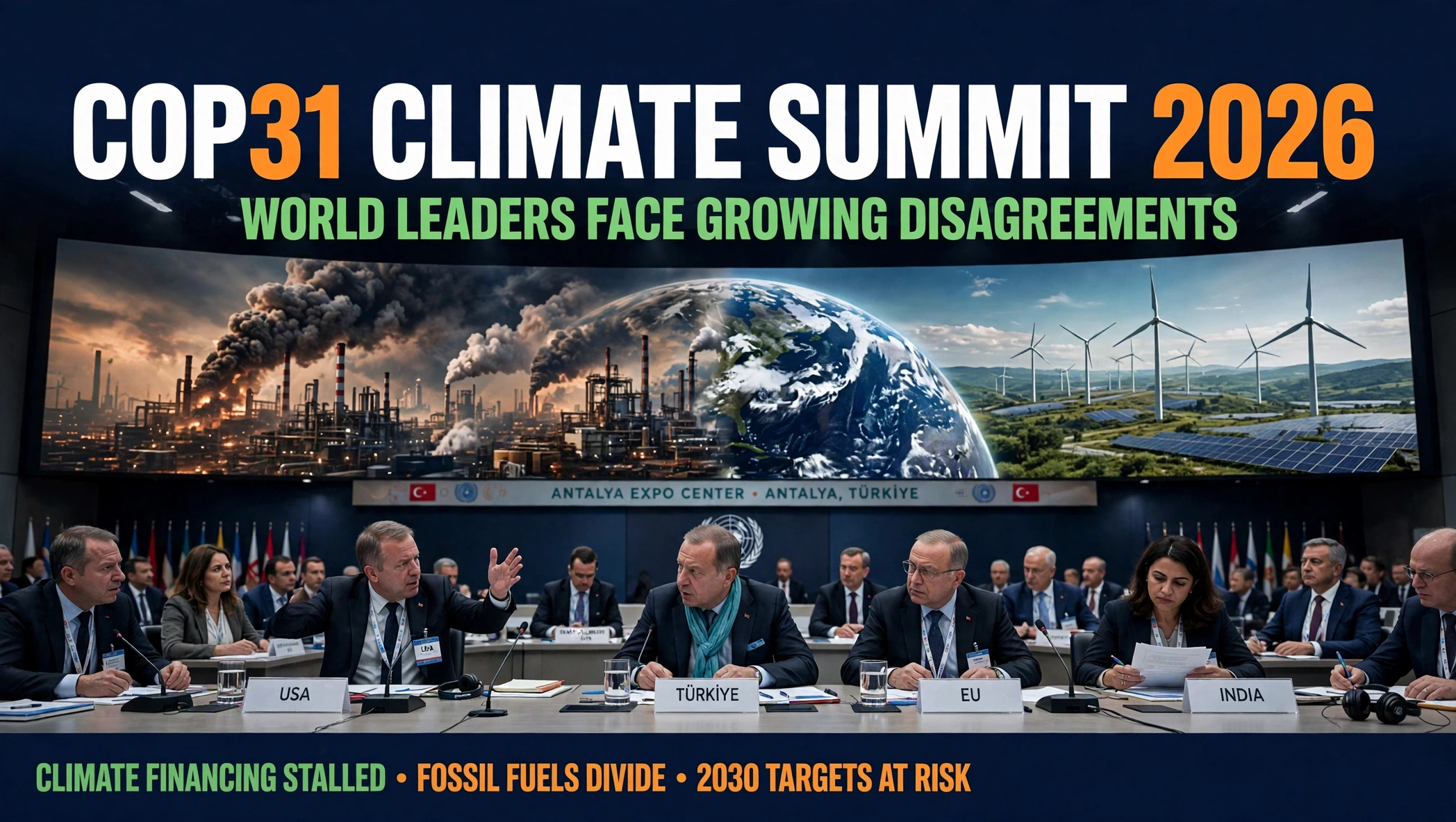
COP31 Climate Negotiations Face Growing Disagreements as Countries Struggle to Reach Global Agreement
ANTALYA, Türkiye – November 19, 2026 – World leaders and climate negotiators are facing growing disagreements at the COP31 United Nations Climate Change Conference as countries struggle to find common ground on fossil fuels, climate financing and the future of global energy.
Taking place in Antalya, Türkiye, from November 9 to 20, the conference has brought together governments, international organisations, environmental campaigners and scientists to discuss how the world can respond to the accelerating climate crisis.
However, as negotiations enter their final stages, significant differences remain between developed and developing nations. While some countries are calling for faster reductions in greenhouse gas emissions, others are demanding greater financial support before accepting stronger climate commitments.
The disagreements highlight a difficult question facing the international community: can governments agree on meaningful climate action when their economic interests and energy priorities remain so different?
Fossil Fuels Remain One of the Biggest Obstacles
The future of coal, oil and natural gas has emerged as one of the most contentious subjects at COP31.
Several countries and environmental organisations are pushing for a clearer international commitment to move away from fossil fuels. They argue that continued dependence on these energy sources is making it increasingly difficult to achieve global climate targets.
However, major fossil fuel producers and some developing economies remain cautious about accepting strict international targets.
Countries with significant oil and gas industries are concerned about the economic consequences of a rapid transition. Meanwhile, developing economies argue that they need affordable and reliable energy to support industrial development, employment and growing populations.
According to reporting by Reuters and Channel NewsAsia, disagreements over whether the final agreement should include specific commitments on fossil fuel reductions have become a major challenge for negotiators.
The debate is not simply about reducing emissions. It also involves energy security, economic development and the future of industries that millions of people depend on.
Climate Financing Creates Another Major Divide
Financial support for developing countries is another central issue at COP31.
Many lower-income nations face serious climate-related challenges, including rising sea levels, extreme temperatures, droughts, flooding and increasingly destructive storms.
Although these countries often contribute relatively little to historical global greenhouse gas emissions, they frequently have fewer financial resources to prepare for climate disasters and rebuild damaged infrastructure.
Developing nations are therefore demanding stronger financial commitments from wealthier countries.
One important issue is the previous agreement to increase international adaptation finance to at least $120 billion annually by 2035. However, questions remain about how this target will be delivered and whether sufficient funding will actually become available.
There is also disagreement over who should contribute, how the money should be distributed and whether financial assistance should come through grants, loans or other arrangements.
For many vulnerable countries, climate financing is not simply an international financial commitment. It is essential for protecting communities, maintaining food security and building resilience against future disasters.
Countries Disagree Over the Future of Global Energy
The transition towards cleaner energy is another issue creating divisions among participating governments.
Türkiye has placed greater electrification at the centre of its COP31 agenda, encouraging countries to expand the use of electricity across transportation, heating and other sectors.
Supporters believe electrification could reduce dependence on fossil fuels and create opportunities for cleaner technologies.
However, governments disagree over how this transition should happen and what energy sources should support the growing demand for electricity.
Some countries want stronger commitments to renewable energy, including solar and wind power. Others are reluctant to accept specific technology-based targets, arguing that national energy circumstances differ considerably.
The European Union has expressed support for greater electrification, while several developing countries have raised concerns about investment costs and the potential consequences of strict international targets.
The challenge is finding an approach that reduces emissions without creating additional economic pressure on countries that already face significant development challenges.
The 1.5°C Climate Target Faces Increasing Pressure
The Paris Agreement established an international ambition to limit global warming to well below 2°C, while pursuing efforts to keep the temperature increase within 1.5°C above pre-industrial levels.
However, scientists have repeatedly warned that current global climate action remains insufficient to achieve this objective without substantial additional emissions reductions.
At COP31, the 1.5°C target remains an important reference point in discussions about emissions reductions, renewable energy investment and international cooperation.
The United Nations has warned that the world is heading towards an overshoot of the 1.5°C temperature threshold.
An overshoot means global temperatures temporarily exceed that level before potentially declining later. However, even temporary warming beyond the threshold could increase the risks of extreme weather, ecosystem damage and other climate-related impacts.
For vulnerable countries, particularly small island nations and coastal communities, the consequences could be devastating.
Climate experts argue that governments must move beyond long-term promises and accelerate practical action to reduce emissions.
Developing Countries Demand Greater Climate Justice
The disagreements at COP31 also reflect wider concerns about climate justice.
Developing countries argue that wealthy industrialised nations have contributed a substantial share of historical greenhouse gas emissions and should therefore take greater responsibility for financing climate action.
They want international agreements to recognise the different economic circumstances of participating countries.
Small island nations and climate-vulnerable communities are particularly concerned about rising sea levels, coastal erosion, extreme weather and the financial burden of recovering from climate disasters.
The issue of loss and damage is therefore receiving considerable attention.
Loss and damage refers to the harmful consequences of climate change that cannot always be prevented through emissions reductions or adaptation measures.
Although an international fund has been established to support countries facing these impacts, questions remain about the amount of money available and how effectively assistance can reach affected communities.
For many developing nations, meaningful progress at COP31 will depend on whether wealthier countries translate previous financial commitments into practical support.
A Divided World Faces Pressure to Reach an Agreement
The COP31 negotiations also reflect the complicated relationship between climate policy and international politics.
Economic uncertainty, geopolitical tensions and concerns about energy security are influencing national decisions.
Some governments are prioritising renewable energy investment and emissions reductions, while others are placing greater emphasis on domestic energy production and economic stability.
The absence of a unified position makes it difficult to negotiate an agreement that satisfies all participating countries.
An unusual leadership arrangement has also attracted attention this year. Türkiye holds the COP31 presidency, while Australia is serving as President of Negotiations under an agreed partnership arrangement.
This arrangement is intended to support the conference process, but the responsibility of bringing nearly 200 delegations towards a common position remains challenging.
A draft decision circulated during the negotiations has highlighted competing proposals on electrification, fossil fuel transitions and climate finance. However, the presence of proposals in a draft does not mean governments have accepted them.
The final outcome will depend on whether countries can compromise on the most difficult issues before the conference concludes.
What Happens If COP31 Fails to Deliver Strong Results?
The consequences of an unsuccessful conference could extend beyond the negotiating rooms in Antalya.
A weak agreement could undermine confidence in international climate cooperation and make it more difficult to achieve the objectives established under the Paris Agreement.
It could also leave vulnerable countries without the financial support and practical assistance they urgently need.
However, even when negotiations produce limited results, international climate conferences can help maintain diplomatic pressure, strengthen cooperation and encourage individual governments to improve their national climate policies.
The important question is whether the commitments announced at these meetings eventually translate into measurable action.
Governments must increase investment in clean energy, improve climate resilience, protect natural ecosystems and establish realistic pathways towards reducing greenhouse gas emissions.
Without implementation, even ambitious international declarations risk becoming little more than political promises.
Conclusion: The World Needs Action, Not Just Climate Promises
COP31 represents another important opportunity for governments to strengthen their collective response to climate change.
However, growing disagreements over fossil fuels, international financing and energy development demonstrate how difficult it remains to establish a shared global strategy.
Developed countries are being challenged to provide stronger financial support, while developing economies are seeking a fair transition that does not undermine their economic progress.
As the conference approaches its scheduled conclusion on November 20, international attention is focused on whether negotiators can overcome these differences and deliver a meaningful agreement.
The climate crisis does not recognise national borders, political divisions or economic competition. Its consequences affect communities across the world, making international cooperation more important than ever.
Ultimately, the success of COP31 will not be measured by the number of speeches delivered or promises announced in Antalya. It will be measured by whether countries are prepared to turn their commitments into real action.
source: United Nations (UN), Reuters, Channel NewsAsia (CNA), International Institute for Sustainable Development (IISD)
XARLIN DESK