Cambridge Dictionary Names ‘Human’ Word of the Year 2026 Amid AI Debate

- Update Time : 02:38:12 pm, Wednesday, 18 November 2026
- / 27 View
Cambridge Dictionary Names ‘Human’ Word of the Year 2026 as AI Raises Questions About Humanity
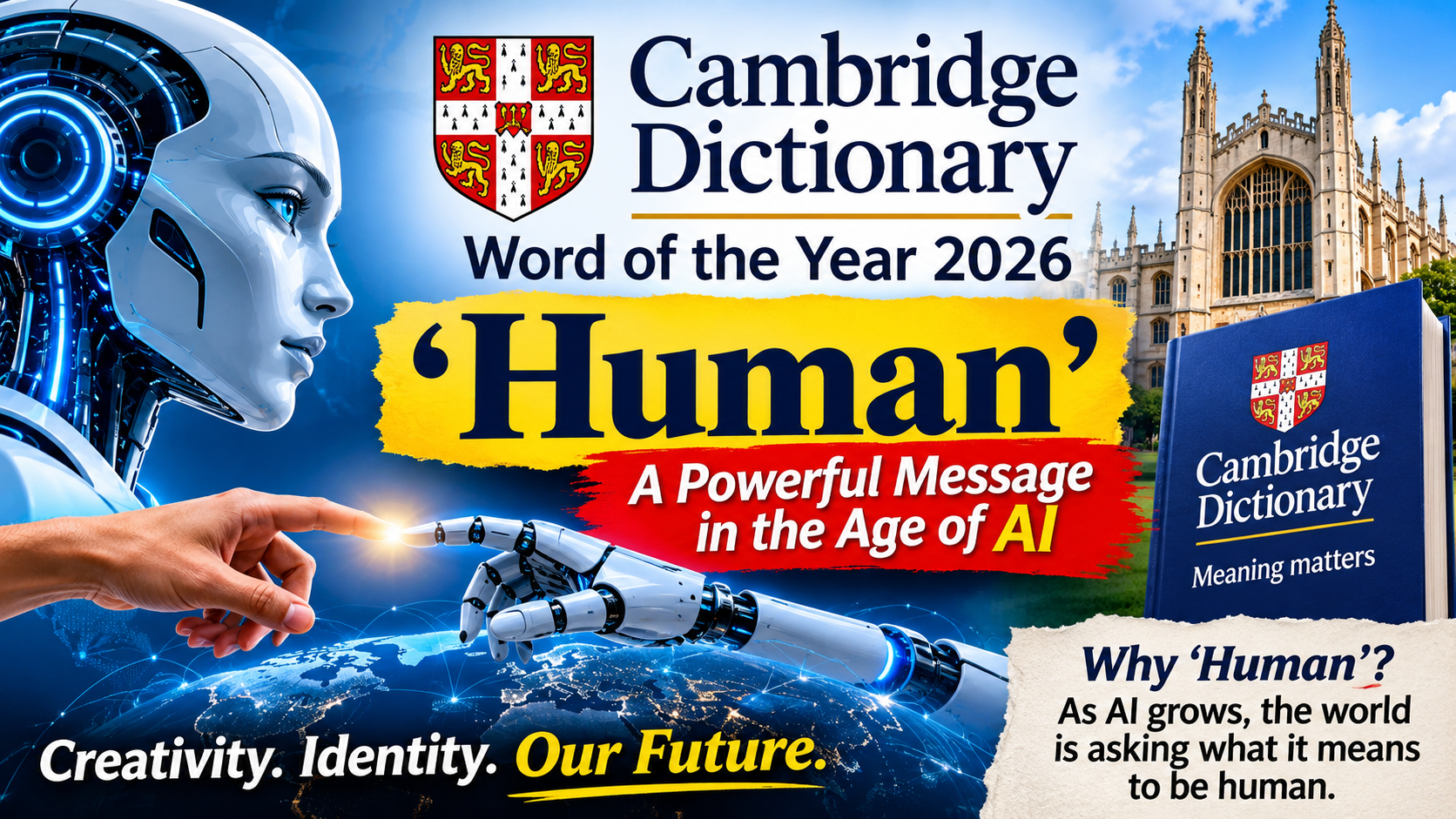
The Cambridge Dictionary has selected “human” as its Word of the Year for 2026, highlighting a growing global debate about what separates people from machines as artificial intelligence continues to transform everyday life.
The announcement reflects a significant cultural shift. As AI systems become increasingly capable of producing text, images, music and other forms of creative work, questions about human intelligence, identity, originality and emotional expression are attracting greater attention.
Rather than choosing a newly invented internet expression or a passing social media trend, Cambridge has selected a familiar word that carries renewed importance in the age of artificial intelligence.
According to Cambridge Dictionary, the decision reflects worldwide discussions about what it means to be human when the boundaries between people and machines are becoming increasingly blurred.
Why Did Cambridge Choose ‘Human’ as Its Word of the Year?
The word “human” has existed in the English language for centuries, but its meaning has gained fresh attention as artificial intelligence becomes more integrated into society.
Cambridge Dictionary defines the adjective “human” as having the qualities, faults and feelings associated with people, as opposed to gods, animals or machines.
According to Cambridge lexicographer Colin McIntosh, artificial intelligence is changing the way people discuss humanity.
The growing use of expressions such as “human-made” also reflects a desire to distinguish work produced by people from material generated by AI.
This distinction is becoming particularly important in industries where artificial intelligence can create content that closely resembles human-produced work.
The dictionary’s selection suggests that the biggest question of the AI era may not simply be how intelligent machines can become, but what qualities people want to preserve as technology advances.
Artificial Intelligence Is Changing the Meaning of Human Creativity
Artificial intelligence has developed rapidly, giving people access to tools that can write articles, generate photographs, compose music, produce videos and assist with complicated research.
These developments have created new opportunities for businesses, students, researchers and creative professionals.
However, they have also raised difficult questions about originality, ownership and the value of human creativity.
Writers, musicians, actors and other creative professionals have increasingly raised concerns about the use of their work in training AI systems and the possibility of unauthorised digital reproductions of their voices and images.
The debate is no longer limited to technology companies. It has become an important discussion across entertainment, education, publishing and the wider creative economy.
Cambridge highlighted these concerns as part of the explanation for its 2026 selection.
The growing interest in identifying human-created work demonstrates how society is reconsidering the relationship between technology and creativity.
Could Artificial Intelligence Replace Some Human Jobs?
Another important issue behind the selection is the future of employment.
AI-powered systems are already helping organisations automate administrative tasks, analyse information, produce reports and improve productivity.
While these developments may create new opportunities, they are also raising concerns about how certain professions could change.
Microsoft co-founder Bill Gates has argued that some roles, particularly those involving essential human care, should remain centred on people.
His comments reflect a broader discussion about the importance of human judgement, empathy and personal relationships in an increasingly automated world.
Jobs involving caregiving, teaching, healthcare and complex interpersonal communication demonstrate why human interaction remains valuable.
However, the future is unlikely to be a simple competition between humans and machines.
In many industries, the greatest changes may come from people working alongside AI rather than being completely replaced by it.
The challenge for governments, employers and educational institutions will be ensuring that technological progress benefits society while workers have opportunities to adapt.
Human Identity in an Age of AI Deepfakes
Another concern highlighted by Cambridge is the increasing ability of artificial intelligence to reproduce human appearances and voices.
AI-generated deepfakes can create convincing videos, photographs and audio recordings that appear to show real people saying or doing things they never actually did.
This technology raises serious questions about privacy, consent, misinformation and personal identity.
Public figures and entertainment professionals have become increasingly concerned about the unauthorised use of their digital likenesses.
Cambridge highlighted examples involving Hollywood actors and musicians who have taken steps to protect their voices, images and creative identities.
These developments show why society needs stronger discussions about digital rights and the responsible use of artificial intelligence.
When technology can imitate a person’s appearance or voice, protecting the rights of the original individual becomes increasingly important.
What Other Words Were Considered for 2026?
“Human” was not the only word considered by Cambridge Dictionary.
Other contenders included:
Agent: A noun describing an artificial intelligence system capable of carrying out complex tasks and making decisions with limited human control.
Analogue: An adjective describing activities, objects or experiences that do not involve digital technology or the internet.
Wholesome: An adjective describing something positive, healthy or beneficial to people’s lives.
These contenders reflect several important cultural and technological developments.
The popularity of AI agents demonstrates growing interest in autonomous technology, while the attention given to analogue experiences reflects interest in activities that offer an alternative to increasingly digital lifestyles.
The selection of “human” brings these themes together by highlighting the relationship between technological progress and human values.
What Does the Word of the Year Mean for the Future?
Cambridge Dictionary’s decision is more than a linguistic announcement. It offers a snapshot of the questions shaping society in 2026.
Artificial intelligence is changing how people work, communicate, learn and create. At the same time, society is trying to establish boundaries around how these technologies should be developed and used.
The selection also raises an important question: as machines become more capable, what should remain uniquely human?
There may not be one simple answer.
Creativity, compassion, responsibility, emotional understanding and independent judgement are among the qualities frequently discussed in debates about humanity and artificial intelligence.
University of Cambridge experts have also emphasised that the future of AI is not predetermined. Decisions made by governments, businesses, researchers and ordinary people will influence how the technology affects society.
Ultimately, the importance of artificial intelligence should be measured not only by what machines can accomplish, but also by whether their capabilities improve human lives.
Conclusion: A Familiar Word With a Powerful Message
By selecting “human” as its 2026 Word of the Year, Cambridge Dictionary has drawn attention to one of the most important discussions of the modern technology era.
Artificial intelligence may continue to become more powerful, but technological progress also makes it necessary to consider human creativity, personal identity, privacy and responsibility.
The word “human” may be centuries old, but its significance is being reconsidered in a world increasingly shaped by machines.
As the relationship between people and artificial intelligence continues to evolve, the biggest challenge may be ensuring that technology remains a tool for humanity rather than allowing humanity to become secondary to technology.
sources: Cambridge University Press & Assessment — Primary Source, University of Cambridge, Associated Press (AP)
XARLIN DESK