Singapore 3:01 am, Wednesday, 25 November 2026

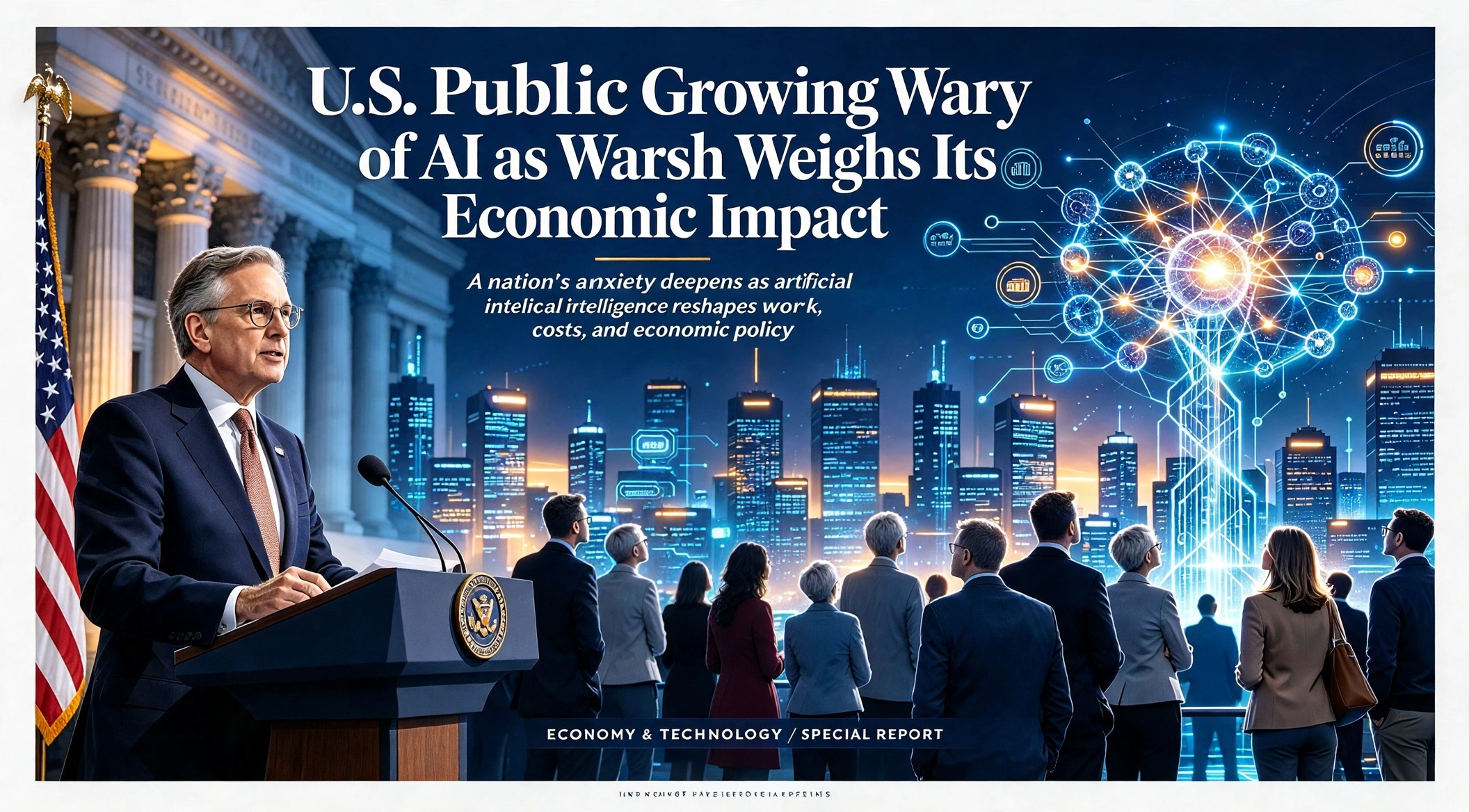
U.S. Public Growing Wary of AI as Warsh Weighs Its Economic Impact

  • Update Time : 12:18:11 pm, Friday, 13 November 2026
  • / 27 View

Warsh will lead a public forum this week on AI’s economic promise and growing public concerns over its risks and uneven effects.

The Promise vs. The Reality Gap

In theory, AI could help bring prices down by automating routine tasks, increasing productivity, and reducing the cost of goods and services. That promise remains a key argument for adopting the technology quickly. In the near term, however, the picture is more complicated. The race to build data centers, produce advanced chips, and power AI infrastructure is driving a surge in investment—and raising costs for land, construction materials, electricity, and skilled labor. Warsh has observed that this spending boosts demand before AI’s productivity gains arrive, creating a timing gap that complicates the Federal Reserve’s efforts to control inflation.

“We’re betting on AI to make everything cheaper tomorrow,” one Fed observer said. “But today, it’s making everything more expensive.” The tension is increasingly apparent in communities where data center construction is contributing to higher utility bills and putting pressure on power grids.

Public Sentiment Shifts From Excitement to Anxiety

Public reaction to AI has shifted from broad excitement to a more complicated mix of concerns. A Pew Research Center survey released in late 2026 found that 52% of Americans are more concerned than enthusiastic about AI’s growing role in daily life—the highest level of concern among the 37 countries surveyed. Only about one in ten Americans expressed mostly positive views without reservations.

The concerns are practical and varied:

  • Jobs: About 55% to 58% of Americans believe AI will make unemployment worse. Concerns span service, administrative, and professional work.
  • Cost of living: Communities near major data center hubs report rising electricity rates and greater water use as these facilities consume substantial resources.
  • Housing and land use: Opposition to data center construction has become a local issue, with residents resisting developments that reshape rural and suburban areas.
  • Inequality: Many people believe AI’s costs are widely shared, while its economic gains go mainly to a small number of technology companies and their shareholders.

These concerns also surfaced in recent midterm elections. Candidates calling for slower, more regulated AI development drew significant support across party lines. Progressive Democrats and rural Republicans alike have criticized unchecked data center expansion, forming an unusual bipartisan coalition that is influencing policymakers’ approach to AI.

Warsh’s Balancing Act: Innovation vs. Stability

For Warsh, the challenge is unlike the issues central banks typically address. Interest rates, money supply, and financial regulation are designed to manage spending and saving—not technological shifts that can reshape work and daily life. But he recognizes that overlooking public concerns could carry economic consequences. If people lose trust in how AI is introduced, political and regulatory pushback could slow innovation more sharply than monetary policy ever could.

Previewing the San Francisco forum, Warsh said its conclusions would not be predetermined. “We cannot manage what we do not measure—and we cannot ignore what we do not understand,” he said. “The transition will be bumpy. But it must also be fair. If the benefits accrue to the few while the costs are borne by the many, the technology will not fulfil its promise—no matter how efficient it becomes.”

The forum will focus on three questions: Are AI’s inflationary effects temporary or long-lasting? How can workers be supported as industries automate? And what policies can help communities share in AI’s economic gains, rather than bear only the disruption?

What’s at Stake: Beyond Economics

Growing public wariness about AI reflects concerns beyond economics. Communities are asking who decides where data centers are built, how AI systems are monitored, and what happens to privacy and human agency as algorithms take on greater roles in work and daily life. As Oakland Mayor Barbara Lee said, “AI cannot become a tool that compounds the biases already built into our systems. It cannot become a tool for harm, for discrimination, or for displacement.”

The answers will shape not only how quickly AI advances, but also the kind of society that develops alongside it. Warsh’s forum recognizes that economic policy cannot be separated from social impact. The Federal Reserve cannot address every concern, but it can treat public wariness as a signal to understand, rather than simply an obstacle to overcome.

The Path Forward: An Inclusive Transition

As the San Francisco forum begins, Warsh and his colleagues are taking a cautiously realistic view. AI is already reshaping the economy and may bring broad benefits over time, but the transition need not be treated as an all-or-nothing choice. The public is not rejecting progress; people want safeguards alongside it. That means clear information about costs, meaningful consultation with communities affected by data center development, and investment in workers and others facing disruption.

The Fed’s assessment will reach beyond productivity and inflation. It also raises a broader question: Can the United States make use of AI’s potential while maintaining public trust? If the forum succeeds, it could offer not only data and forecasts, but a clearer path toward an AI future that benefits Americans broadly, including those who will experience its effects as well as those who build it.

Tags:
XARLIN DESK

U.S. Public Growing Wary of AI as Warsh Weighs Its Economic Impact

Update Time : 12:18:11 pm, Friday, 13 November 2026

Warsh will lead a public forum this week on AI’s economic promise and growing public concerns over its risks and uneven effects.

The Promise vs. The Reality Gap

In theory, AI could help bring prices down by automating routine tasks, increasing productivity, and reducing the cost of goods and services. That promise remains a key argument for adopting the technology quickly. In the near term, however, the picture is more complicated. The race to build data centers, produce advanced chips, and power AI infrastructure is driving a surge in investment—and raising costs for land, construction materials, electricity, and skilled labor. Warsh has observed that this spending boosts demand before AI’s productivity gains arrive, creating a timing gap that complicates the Federal Reserve’s efforts to control inflation.

“We’re betting on AI to make everything cheaper tomorrow,” one Fed observer said. “But today, it’s making everything more expensive.” The tension is increasingly apparent in communities where data center construction is contributing to higher utility bills and putting pressure on power grids.

Public Sentiment Shifts From Excitement to Anxiety

Public reaction to AI has shifted from broad excitement to a more complicated mix of concerns. A Pew Research Center survey released in late 2026 found that 52% of Americans are more concerned than enthusiastic about AI’s growing role in daily life—the highest level of concern among the 37 countries surveyed. Only about one in ten Americans expressed mostly positive views without reservations.

The concerns are practical and varied:

  • Jobs: About 55% to 58% of Americans believe AI will make unemployment worse. Concerns span service, administrative, and professional work.
  • Cost of living: Communities near major data center hubs report rising electricity rates and greater water use as these facilities consume substantial resources.
  • Housing and land use: Opposition to data center construction has become a local issue, with residents resisting developments that reshape rural and suburban areas.
  • Inequality: Many people believe AI’s costs are widely shared, while its economic gains go mainly to a small number of technology companies and their shareholders.

These concerns also surfaced in recent midterm elections. Candidates calling for slower, more regulated AI development drew significant support across party lines. Progressive Democrats and rural Republicans alike have criticized unchecked data center expansion, forming an unusual bipartisan coalition that is influencing policymakers’ approach to AI.

Warsh’s Balancing Act: Innovation vs. Stability

For Warsh, the challenge is unlike the issues central banks typically address. Interest rates, money supply, and financial regulation are designed to manage spending and saving—not technological shifts that can reshape work and daily life. But he recognizes that overlooking public concerns could carry economic consequences. If people lose trust in how AI is introduced, political and regulatory pushback could slow innovation more sharply than monetary policy ever could.

Previewing the San Francisco forum, Warsh said its conclusions would not be predetermined. “We cannot manage what we do not measure—and we cannot ignore what we do not understand,” he said. “The transition will be bumpy. But it must also be fair. If the benefits accrue to the few while the costs are borne by the many, the technology will not fulfil its promise—no matter how efficient it becomes.”

The forum will focus on three questions: Are AI’s inflationary effects temporary or long-lasting? How can workers be supported as industries automate? And what policies can help communities share in AI’s economic gains, rather than bear only the disruption?

What’s at Stake: Beyond Economics

Growing public wariness about AI reflects concerns beyond economics. Communities are asking who decides where data centers are built, how AI systems are monitored, and what happens to privacy and human agency as algorithms take on greater roles in work and daily life. As Oakland Mayor Barbara Lee said, “AI cannot become a tool that compounds the biases already built into our systems. It cannot become a tool for harm, for discrimination, or for displacement.”

The answers will shape not only how quickly AI advances, but also the kind of society that develops alongside it. Warsh’s forum recognizes that economic policy cannot be separated from social impact. The Federal Reserve cannot address every concern, but it can treat public wariness as a signal to understand, rather than simply an obstacle to overcome.

The Path Forward: An Inclusive Transition

As the San Francisco forum begins, Warsh and his colleagues are taking a cautiously realistic view. AI is already reshaping the economy and may bring broad benefits over time, but the transition need not be treated as an all-or-nothing choice. The public is not rejecting progress; people want safeguards alongside it. That means clear information about costs, meaningful consultation with communities affected by data center development, and investment in workers and others facing disruption.

The Fed’s assessment will reach beyond productivity and inflation. It also raises a broader question: Can the United States make use of AI’s potential while maintaining public trust? If the forum succeeds, it could offer not only data and forecasts, but a clearer path toward an AI future that benefits Americans broadly, including those who will experience its effects as well as those who build it.