Singapore 12:18 pm, Wednesday, 25 November 2026

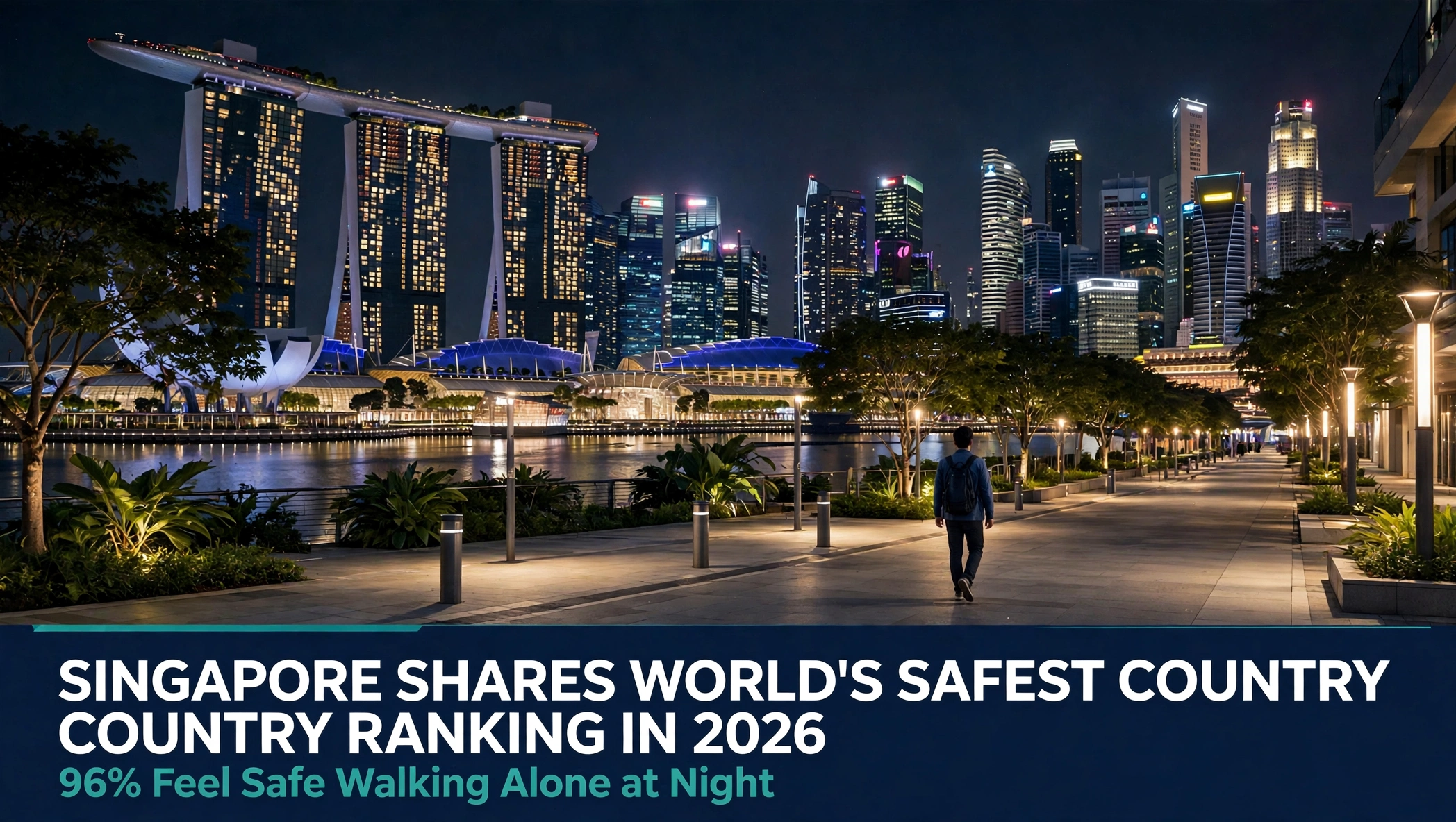
Singapore Shares World’s Safest Country Ranking in 2026

  • Update Time : 03:36:35 pm, Thursday, 19 November 2026
  • / 23 View

Singapore Shares World’s Safest Country Ranking as 96% Feel Safe Walking Alone at Night

Singapore has once again demonstrated its strong reputation for public safety, sharing the world’s highest ranking with the United Arab Emirates after 96% of adults in both countries said they felt safe walking alone at night, according to the 2026 Gallup Global Safety Report.

Singapore has secured its position among the world’s safest places to live, according to new international research measuring how people experience personal safety in their communities.

The latest findings, published by Gallup on November 17, 2026, reveal that 96% of adults in Singapore and the United Arab Emirates feel safe walking alone at night in the area where they live. The two countries are statistically tied at the top of the global ranking.

The findings are based on surveys conducted during 2025 across 140 countries and territories, covering more than 143,000 adults aged 15 and above.

For Singapore, the result reinforces its long-standing reputation for public security and personal safety. The country has led Gallup’s global perceptions of safety rankings on 12 occasions since the organisation began tracking the measure in 2006.

The latest report also provides an interesting picture of how people experience safety in different parts of the world, with several Asian and Middle Eastern countries recording particularly high results.

Singapore and UAE Lead the Global Safety Rankings

According to Gallup’s 2026 Global Safety Report, Singapore and the United Arab Emirates recorded the highest levels of perceived personal safety, with 96% of adults in each country saying they felt safe walking alone at night.

Other countries also performed strongly.

The top 10 results include:

Country or Territory Adults Feeling Safe
singapore 96%
United Arab Emirates 96%
Saudi Arabia 95%
Tajikistan 93%
Kuwait 93%
Bahrain 92%
Hong Kong 90%
El Salvador 90%
Switzerland 90%
Norway 90%

The results demonstrate that high levels of perceived personal safety are not limited to one geographical region.

Countries in the Middle East, Asia and Europe all appear among the highest-ranked locations.

Saudi Arabia, Kuwait and Bahrain also recorded particularly strong results, highlighting the performance of several Gulf countries in the international survey.

Why Does Singapore Perform So Well?

Singapore’s strong performance reflects a combination of factors that contribute to how residents experience everyday security.

Public security, effective policing, urban planning and well-maintained public infrastructure are important parts of the country’s approach to creating a safe urban environment.

The city-state has developed an extensive network of public transport, pedestrian pathways, residential neighbourhoods and commercial areas that support everyday movement.

Its public spaces also remain active beyond traditional working hours, with shopping districts, restaurants, transport stations and neighbourhood centres serving residents throughout the day and evening.

Confidence in law enforcement is another important consideration when examining public safety.

When people trust that authorities can respond to security concerns, they may feel more comfortable using public spaces.

However, Gallup’s findings measure people’s reported feelings of safety. They should not be interpreted as proof that crime does not occur or that every neighbourhood and individual experiences the same level of security.

How Does Singapore Compare With Australia, Japan and the United States?

The report also highlights considerable differences between countries that are often considered attractive destinations for international travellers and residents.

In the Asia-Pacific region, Singapore recorded the highest result, with 96% of adults feeling safe walking alone at night.

Hong Kong followed at 90%, while Taiwan recorded 88%.

Other countries included:

  • Vietnam: 87%
  • Indonesia: 85%
  • South Korea: 85%
  • Japan: 80%
  • Australia: 64%
  • New Zealand: 66%
  • Malaysia: 62%
  • Philippines: 61%

The United States recorded 78%, while Canada reached 75%.

These figures demonstrate that perceptions of personal safety can differ considerably even among economically developed countries.

For international travellers, the results provide an interesting perspective when comparing destinations. However, they should be considered alongside other factors, including local crime statistics, transport safety, neighbourhood conditions and individual travel circumstances.

Global Feelings of Safety Decline in 2025

While Singapore and the UAE recorded exceptionally high results, the global picture was less encouraging.

Gallup found that 69% of adults worldwide felt safe walking alone at night in 2025.

This represented a four-percentage-point decline from 73% in 2024.

Although the latest figure remains above the 60% recorded in 2014, the decline suggests that perceptions of personal security remain an important international concern.

The findings also demonstrate that feelings of safety are not determined by economic development alone.

Local conditions, confidence in law enforcement, experiences of crime and wider social circumstances can all influence how people view their personal security.

The difference between countries also highlights the importance of examining public safety through both statistical information and people’s everyday experiences.

What Makes the Gallup Safety Report Important?

Gallup’s Global Safety Report is an international research project designed to understand how people experience security in their communities.

For its 2026 edition, the organisation collected responses from 143,620 adults aged 15 and older across 140 countries and territories.

One of the central questions asked participants whether they felt safe walking alone at night in the city or area where they lived.

The survey also examined confidence in local police and people’s experiences of theft, physical assault and robbery.

These additional questions contribute to Gallup’s Law and Order Index, which measures broader perceptions and experiences of security.

The research is based on nationally representative probability samples. In most countries, interviews involved approximately 1,000 or more respondents, although survey methods varied between locations.

The distinction between perceived safety and recorded crime is important. People’s feelings provide valuable information about everyday security, but they do not replace official crime statistics or other measures of public safety.

What the Ranking Means for Singapore’s International Reputation

Singapore’s latest result reinforces its position as an attractive destination for international visitors, professionals, students and businesses.

Personal safety is an important consideration when people choose where to travel, study, work or establish a home.

For tourists, feeling comfortable walking through public areas in the evening can contribute to a positive travel experience.

For international businesses, a stable and secure environment can also influence decisions about investment, employee relocation and regional operations.

Singapore already has an established reputation as an international financial, commercial and transport centre. Its latest Gallup result adds another positive dimension to its global image.

Nevertheless, maintaining public confidence requires continued attention to policing, community engagement, infrastructure and emerging security challenges.

Singapore’s Strong Safety Reputation Continues

The 2026 Gallup Global Safety Report provides another significant result for Singapore, with 96% of adults reporting that they feel safe walking alone at night.

Although the United Arab Emirates shares the same percentage and is numerically ranked first, Gallup confirms that the difference between the two countries is not statistically significant.

The findings also reveal a wider international challenge: while some countries continue to record exceptionally high levels of perceived safety, global confidence declined in 2025.

For Singapore, the latest result strengthens an already established international reputation.

As countries continue to address public security, urban development and changing social conditions, the question of how safe people feel in their everyday lives will remain an important measure of national well-being.

Sources: Gallup Global Safety Report, Gallup Research and Methodology, The National

XARLIN DESK

Singapore Shares World’s Safest Country Ranking in 2026

Update Time : 03:36:35 pm, Thursday, 19 November 2026

Singapore Shares World’s Safest Country Ranking as 96% Feel Safe Walking Alone at Night

Singapore has once again demonstrated its strong reputation for public safety, sharing the world’s highest ranking with the United Arab Emirates after 96% of adults in both countries said they felt safe walking alone at night, according to the 2026 Gallup Global Safety Report.

Singapore has secured its position among the world’s safest places to live, according to new international research measuring how people experience personal safety in their communities.

The latest findings, published by Gallup on November 17, 2026, reveal that 96% of adults in Singapore and the United Arab Emirates feel safe walking alone at night in the area where they live. The two countries are statistically tied at the top of the global ranking.

The findings are based on surveys conducted during 2025 across 140 countries and territories, covering more than 143,000 adults aged 15 and above.

For Singapore, the result reinforces its long-standing reputation for public security and personal safety. The country has led Gallup’s global perceptions of safety rankings on 12 occasions since the organisation began tracking the measure in 2006.

The latest report also provides an interesting picture of how people experience safety in different parts of the world, with several Asian and Middle Eastern countries recording particularly high results.

Singapore and UAE Lead the Global Safety Rankings

According to Gallup’s 2026 Global Safety Report, Singapore and the United Arab Emirates recorded the highest levels of perceived personal safety, with 96% of adults in each country saying they felt safe walking alone at night.

Other countries also performed strongly.

The top 10 results include:

Country or Territory Adults Feeling Safe
singapore 96%
United Arab Emirates 96%
Saudi Arabia 95%
Tajikistan 93%
Kuwait 93%
Bahrain 92%
Hong Kong 90%
El Salvador 90%
Switzerland 90%
Norway 90%

The results demonstrate that high levels of perceived personal safety are not limited to one geographical region.

Countries in the Middle East, Asia and Europe all appear among the highest-ranked locations.

Saudi Arabia, Kuwait and Bahrain also recorded particularly strong results, highlighting the performance of several Gulf countries in the international survey.

Why Does Singapore Perform So Well?

Singapore’s strong performance reflects a combination of factors that contribute to how residents experience everyday security.

Public security, effective policing, urban planning and well-maintained public infrastructure are important parts of the country’s approach to creating a safe urban environment.

The city-state has developed an extensive network of public transport, pedestrian pathways, residential neighbourhoods and commercial areas that support everyday movement.

Its public spaces also remain active beyond traditional working hours, with shopping districts, restaurants, transport stations and neighbourhood centres serving residents throughout the day and evening.

Confidence in law enforcement is another important consideration when examining public safety.

When people trust that authorities can respond to security concerns, they may feel more comfortable using public spaces.

However, Gallup’s findings measure people’s reported feelings of safety. They should not be interpreted as proof that crime does not occur or that every neighbourhood and individual experiences the same level of security.

How Does Singapore Compare With Australia, Japan and the United States?

The report also highlights considerable differences between countries that are often considered attractive destinations for international travellers and residents.

In the Asia-Pacific region, Singapore recorded the highest result, with 96% of adults feeling safe walking alone at night.

Hong Kong followed at 90%, while Taiwan recorded 88%.

Other countries included:

  • Vietnam: 87%
  • Indonesia: 85%
  • South Korea: 85%
  • Japan: 80%
  • Australia: 64%
  • New Zealand: 66%
  • Malaysia: 62%
  • Philippines: 61%

The United States recorded 78%, while Canada reached 75%.

These figures demonstrate that perceptions of personal safety can differ considerably even among economically developed countries.

For international travellers, the results provide an interesting perspective when comparing destinations. However, they should be considered alongside other factors, including local crime statistics, transport safety, neighbourhood conditions and individual travel circumstances.

Global Feelings of Safety Decline in 2025

While Singapore and the UAE recorded exceptionally high results, the global picture was less encouraging.

Gallup found that 69% of adults worldwide felt safe walking alone at night in 2025.

This represented a four-percentage-point decline from 73% in 2024.

Although the latest figure remains above the 60% recorded in 2014, the decline suggests that perceptions of personal security remain an important international concern.

The findings also demonstrate that feelings of safety are not determined by economic development alone.

Local conditions, confidence in law enforcement, experiences of crime and wider social circumstances can all influence how people view their personal security.

The difference between countries also highlights the importance of examining public safety through both statistical information and people’s everyday experiences.

What Makes the Gallup Safety Report Important?

Gallup’s Global Safety Report is an international research project designed to understand how people experience security in their communities.

For its 2026 edition, the organisation collected responses from 143,620 adults aged 15 and older across 140 countries and territories.

One of the central questions asked participants whether they felt safe walking alone at night in the city or area where they lived.

The survey also examined confidence in local police and people’s experiences of theft, physical assault and robbery.

These additional questions contribute to Gallup’s Law and Order Index, which measures broader perceptions and experiences of security.

The research is based on nationally representative probability samples. In most countries, interviews involved approximately 1,000 or more respondents, although survey methods varied between locations.

The distinction between perceived safety and recorded crime is important. People’s feelings provide valuable information about everyday security, but they do not replace official crime statistics or other measures of public safety.

What the Ranking Means for Singapore’s International Reputation

Singapore’s latest result reinforces its position as an attractive destination for international visitors, professionals, students and businesses.

Personal safety is an important consideration when people choose where to travel, study, work or establish a home.

For tourists, feeling comfortable walking through public areas in the evening can contribute to a positive travel experience.

For international businesses, a stable and secure environment can also influence decisions about investment, employee relocation and regional operations.

Singapore already has an established reputation as an international financial, commercial and transport centre. Its latest Gallup result adds another positive dimension to its global image.

Nevertheless, maintaining public confidence requires continued attention to policing, community engagement, infrastructure and emerging security challenges.

Singapore’s Strong Safety Reputation Continues

The 2026 Gallup Global Safety Report provides another significant result for Singapore, with 96% of adults reporting that they feel safe walking alone at night.

Although the United Arab Emirates shares the same percentage and is numerically ranked first, Gallup confirms that the difference between the two countries is not statistically significant.

The findings also reveal a wider international challenge: while some countries continue to record exceptionally high levels of perceived safety, global confidence declined in 2025.

For Singapore, the latest result strengthens an already established international reputation.

As countries continue to address public security, urban development and changing social conditions, the question of how safe people feel in their everyday lives will remain an important measure of national well-being.

Sources: Gallup Global Safety Report, Gallup Research and Methodology, The National